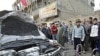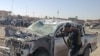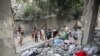



A suicide-bomber blew himself up Tuesday in the midst of a crowd of aspiring police recruits in the Sunni-Arab town of Tikrit, north of Baghdad. The bloody bombing left at least 50 people dead and wounded at least 150 others. The attack appears to mark a strategy by insurgents of targeting Iraq’s fledgling security forces, as
The bombing resembled many other similar attacks on Iraqi security forces in recent months. Dozens of aspiring, mostly young police recruits were killed or wounded by the blast in front of the police station in Saddam Hussein’s hometown.
Baghdad TV reports that the casualties were numerous and that many had to be taken to hospitals in other area towns and cities. Local mosques also broadcast appeals for blood donations over loudspeakers.
One wounded young man, his face covered with blood and soot from the explosion, described the blast from his hospital bed:
He says that he felt what had to have been an extremely strong explosion around him.
Peter Harling of the Crisis Group in Damascus says that insurgents continue to try to change the political equation or dynamics in Iraq by hitting the country’s security forces, but without much success:
"I think what's left of the insurgency has refocused on two types of targets, the security apparatus on the one hand, and on the other hand we've had a string of attacks along the Arab-Kurdish fault line (and on) former Mehdi Army strongholds in Baghdad. I think these attacks are designed to try and change the dynamics in Iraq. They've failed to do so. It's quite striking that although 2010 was marked by protracted negotiations over the formation of a government over a period of 8 months, these attacks completely failed in their objective of changing the dynamics," he said.
Harling argues that the insurgency would ultimately need to change its strategy of blowing people up in order to have more impact on the political process. "They've been successful only in causing massive bloodshed, but haven't had a decisive impact in terms of the dynamics of this conflict, and that I think leaves the insurgency very much in disarray. So, whatever operations they are mounting have no concrete impact and in no way can garner wide-ranging popular support in Iraq," he said.
Several Iraqi officials accused al-Qaida of responsibility for the blast. Peter Harling, however, says it is not clear who is behind the bombing, or Iraq’s insurgency, but that they are using techniques inspired by al-Qaida, notably in Afghanistan. What’s left of the insurgency, he adds, is mostly composed of small cells, but not backed up by any significant popular support.