



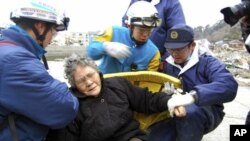
Japanese rescuers have pulled an 80-year-old woman and her grandson alive from the wreckage of their home in Miyagi Prefecture, nine days after an earthquake and tsunami devastated the region.
It is the good news story that the Japanese people have been craving.
An 80-year-old woman and her 16-year-old grandson - found alive and pulled to safety from the wreckage of their house in Ishinomaki, Miyagi Prefecture.
Local media report they survived by eating yoghurt from the fridge.
They have survived nine nights of freezing temperatures and heavy snow. The boy is reported to have a low temperature, but is conscious.
It will reinvigorate the rescue effort here.
For days, Japanese and international teams have searched up and down the wrecked local coastline in vain. Miyagi police say 15,000 people probably died in their prefecture.
On a windswept embankment surrounded by rice paddies and wrecked houses lies the body of a teenage boy. The boy, wrapped in blankets, lies near the town of Natori in Miyagi, a nameless corpse yet to be collected and taken to the overwhelmed morgue.
Rescuers say there are many more bodies among the wreckage of this town. The rest of the missing, they say, were probably washed out to sea.
Natori was on the frontline when the tsunami smashed into the shoreline. Anyone who had not escaped this flat coastal plain had little chance.
Now a clock hanging from the remains of a house here is frozen at 2:46 - the moment the earthquake struck.
At the nearby Tozen-ji shrine, Yukihiro Soga cuts a lonely figure. The granite gravestones lie smashed across the grounds, the shrine building one of the few in the town to still be standing.
Soga has come here to collect the bones of his parents.
“It is not so hard to sift through the soil, the bone fragments are much lighter than the stones,” says he.
It may seem a grim task, but Soga says it is his duty to his parents.
“The power of the human race is nothing compared to nature he says. We have to live in harmony with nature. The tsunami caused such huge destruction that I do not feel anger. I am lucky that my family all survived this. So we have a new start - we start from zero. I am going to live here with nature. My roots are here. My parents are here."
Like Soga, thousands of people up and down the coastline have felt the full force of nature, and must now start from zero.