



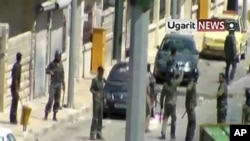
The Syrian government is defying international criticism of its crackdown on a popular uprising, relying on its armed forces to suppress political dissent. Unlike its counterparts during similar unrest in Egypt and Tunisia, Syria's military has given few signs of breaking with the ruling elite.
Security forces that moved into yet more Syrian towns this week have shown little hesitation in opening fire on civilian areas. President Bashar al-Assad says the troops are acting out of national duty to counter what he calls outlaws, an interpretation of events rejected even by his allies.
Despite the ferocity with which the operations are being carried out, opposition to the crackdown is likely among at least some of the military's rank and file. Most foot soldiers are from Syria's Sunni majority, long-dominated by the Assad family's Alawite minority.
They are also closer in social and economic terms to the victims of the crackdown than they are to the nation's rulers, with some coming from the very neighborhoods they must now attack. Their officers, however, are disproportionately Alawite.

And according to human rights groups, commanders are willing to use brutal measures to ensure orders are carried out. Witnesses say soldiers who have refused to open fire on civilians have themselves been shot and killed.
A few have managed to escape.
One of the dozens of deserters who have turned up in Lebanon called on others in the Syrian army to reject the government's commands.
But such well-publicized defections are limited.
"The army in Syria is composed of one million and a half. You cannot talk about 20 cases here and 50 cases there," said Haytham Manna, who is with the Arab Commission for Human Rights.
So far no brigade, let alone a division, has turned against the government. Part of the cohesion can be attributed to the command structure. Key positions in the security apparatus are held by relatives of President Assad, including his brother Maher and brother-in-law Assaf Chawkat.
It is a style of family rule seen in Libya and Yemen, where similar uprisings have also been met with force. Perhaps more importantly, power is divided under a complex system devised by former President Hafez al-Assad, Bashar's father, to decrease the chance of an internal coup.
This has tied security forces far closer to the leadership than, say, in Egypt or Tunisia. In both those nations, the military proved an institution unto itself, and its support of the protest movements was key to the uprisings' success.
Nadim Shehadeh, a political analyst at Chatham House, says if Syria's political and military leaders were to fall, they would likely fall together.
"I think what you will find is a crumbling of the whole structure because the inner circle are people that are very tight together," said Shehadeh. "But they are also afraid of any defections or any internal coup. So, if anyone is suspected of being capable of such a defection, he would be dead already."
But human rights monitor Manna believes its not too late for the military to act independently.
"The most important thing is a position from the military apparatus as a whole," said Manna.
Manna argues that the military might be deterred by the prospect of a civil war.
But as the military operations continue, hopes of avoiding a broader conflict are fading.