



Envoys from South and North Korea are expected to meet in Beijing on Wednesday. It will be the latest attempt to get multinational talks about North Korea’s nuclear weapons program back up and running after a nearly three-year stalemate. But, the North’s nuclear arsenal is not the only inter-Korean issue that has been grabbing attention lately. There has been renewed enthusiasm for constructing a natural gas pipeline from Russia that would run across the Korean peninsula.
Momentum gained
Talk of building a pipeline that would deliver Russian natural gas to South Korea by way of North Korea has been going on for decades.
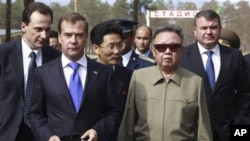
But the project recently gained new momentum when North Korean ruler Kim Jong-il paid Russian President Dmitry Medvedev a visit in Siberia.
Footage aired on Russian television shows the two leaders shaking hands ahead of their summit last month. Reports say both men agreed that construction of a gas pipeline should finally be realized.
Following that meeting, officials in South Korea’s energy sector made it clear that they too want to see the pipeline finally built.
Last week, the president of South Korea’s state-run Korea Gas Corporation met with representatives of the Russian energy firm, Gazprom. The agency says that the officials worked out a road map for future gas deliveries to South Korea.
Government estimates say the pipeline would cost $3.4 billion to construct. But some analysts say, in the long run, it will pay off for South Korea.
Kang Hee-chan is an environmental and energy analyst at the Samsung Economic Research Institute in Seoul.
“Our gas demands continue to grow. Most of the gas is from the shipping from Europe and West Asia. Those options are very costly," Kang noted. "When we can get gas from Russia through North Korea, it’s more cost competitive.”
Shared pipeline not without risks
Despite those savings, current tensions on the Korean peninsula mean the benefits might not outweigh the risks.
“In the long run, this is a very good project, its good both from the economic and political point of view," said Russia native Andrei Lankov, a North Korea analyst at Seoul’s Kookmin University. "However, in order to succeed it needs [a] stable climate of cooperation, exchanges and trust. Frankly I don’t see such climate coming anytime soon.”
Lankov says a shared natural gas pipeline would pose risks for all parties involved, but especially for South Korea.
He says Pyongyang could steal gas or even turn the pipeline off if inter-Korean relations sour. Lankov adds that Seoul would need to have a contingency plan to compensate for that loss if tensions rise.
Building public support
In a report this week to South Korea’s National Assembly, the ministry of knowledge economy said that it will consider all risks involved in doing business with North Korea. The ministry added that, for the moment, there have been no discussions with Moscow or Pyongyang on the terms of a contract.
But, already South Korean politicians are trying to build-up public support for the pipeline.
During an interview on Korean television earlier this month, President Lee Myung Bak said it is only a matter of time before the project begins.
President Lee said that both Koreas are already talking with Russia separately about the pipeline. He predicts that, at some point, all three countries will reach an agreement. He says the project could proceed faster than expected and it will be a great business if it works out.
Analyst Andrei Lankov says many politicians here are trying to win support for the pipeline by promoting it as a step closer toward unification with North Korea.
He says that is just wishful thinking. “It’s a very usual type of official rhetoric in Korea. All kinds of exchanges between the two Korean states is always described as something related to unification. It’s convenient, it sells very well to the nationalistic Korean public, but let’s be frank, it has nothing to do with unification is just normal economic exchanges and nothing else,” Lankov said.
Further talks between South Koran and Russia could occur later this year when Presidents Lee and Medvedev meet at the G-20 summit in Paris.