



The United States and China have begun two days of talks on human rights in Beijing amid differing opinions about China’s ongoing crackdown on dissent.
Human rights is one area in which the U.S. and Chinese governments tend to disagree more than they agree.
The U.S. State Department’s annual human-rights report, issued earlier this month, singles out China for criticism. It says Beijing has stepped up restrictions on critics, tightened control on civil society and disrupted free speech and Internet access.
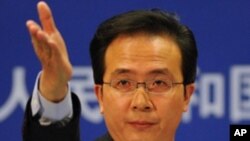
Chinese Foreign Ministry Spokesman Hong Lei has responded by urging Washington to stop being, in his words, a preacher of human rights.
Hong urges the United States to examine its own human-rights record and to stop using its human-rights report to interfere in other countries’ internal affairs.
China criticized the United States for things like homelessness, violent crime and the high number of people in jail.
Beijing also accused Western countries of engaging in an anti-China conspiracy when jailed Chinese dissident Liu Xiaobo was awarded the Nobel Peace prize last year. Shortly afterwards, Chinese authorities began rounding up dozens of lawyers and activists around the country, apparently unnerved by calls for Chinese demonstrations like those that are rocking the Middle East.
The highest-profile detainee is well-known artist Ai Weiwei, who disappeared into police custody earlier this month. Western governments have called for his release.
It is under this kind of atmosphere that officials from both countries sat down in Beijing to talk about human rights.
Some human-rights activists have questioned the effectiveness of the talks, and say they could marginalize the issue.
But Mao Yushi, a liberal economist in Beijing who advocates democratic reform, says attention to China’s human-rights record from outside of the country is essential.
Mao says that in China’s current political environment, the government suppresses forces within the country calling for human rights. He says foreign criticism is extremely important for the progress of human rights in China.
The annual Sino-American human rights dialogue has suffered, in the past, from disagreements between Washington and Beijing. The talks were suspended between 2004 and 2008 because Beijing was angry at Washington for sponsoring a resolution criticizing China at the United Nations Human Rights Commission.
The current round of talks is to end Thursday.