



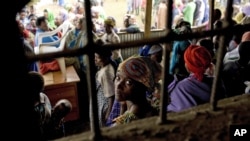
More than 6,000 Congolese refugees have crossed into Rwanda in the last 10 days, fleeing fighting between the army and mutineers.
Mukakarimba, a wife and mother of two, walked for more than three days through the volatile North Kivu region of the eastern Democratic Republic of Congo before she finally reached the Rwandan border. She cries as she explains her ordeal.
She says war has broken out in Congo and the fighting forced her and her family to flee into the forest. She says that, in the chaos, she lost her husband and her daughter. She does not know what became of them.
The recent influx of refuges into Rwanda from neighboring Congo, began 10 days ago following clashes between the Congolese army and former soldiers loyal to Bosco Ntaganda, a militia leader wanted by the International Criminal Court for alleged war crimes.
The flow of refugees crossing Rwanda’s La Corniche border post in Gisenyi has since continued, with a slow but steady trickle of new arrivals crossing into the country at all hours.
Some refugees are working with officials to build additional shelters at Rwanda’s Nkamira Transit Center, 22 kilometers from the border with the DRC. The center is operating at more than double its current capacity. Anouck Bronee is the external relations officer for the United Nations High Commissioner for Refugees in Rwanda.
“The capacity of Nkamira Transit center is 5,000, when all the shelters are fully operational," said Bronee. "Currently we are working on rehabilitating 19 shelters and building another 13 to boost the capacity of the center. In partnership with the Ministry of Disaster Management and Refugee Affairs and other UN partners such as UNICEF, World Food Program, WHO, UNFPA, UNDP, we’re working together to try and increase the capacity of the center.”
Although much of the focus on the current crisis has been directed towards the hunt for Bosco Ntaganda, Rwanda Foreign Affairs Minister Louise Mushikiwabo says attention should be directed towards the larger issues facing the region.
“One individual is not worth the lives of so many Congolese," said Mushikiwabo. "That’s really a very important point. So as much as it’s sexy and there’s a campaign and all of that, let’s think about the ordinary Congolese citizens. They deserve peace and they deserve to be cared for like anybody else.”
The conflict began last week, after hundreds of Ntaganda loyalists deserted the army. The loyalists defected because President Joseph Kabila said Ntaganda should be arrested, though the president specified the warlord should be tried in Congo, not handed over to the ICC.
Mukakarimba, a wife and mother of two, walked for more than three days through the volatile North Kivu region of the eastern Democratic Republic of Congo before she finally reached the Rwandan border. She cries as she explains her ordeal.
She says war has broken out in Congo and the fighting forced her and her family to flee into the forest. She says that, in the chaos, she lost her husband and her daughter. She does not know what became of them.
The recent influx of refuges into Rwanda from neighboring Congo, began 10 days ago following clashes between the Congolese army and former soldiers loyal to Bosco Ntaganda, a militia leader wanted by the International Criminal Court for alleged war crimes.
The flow of refugees crossing Rwanda’s La Corniche border post in Gisenyi has since continued, with a slow but steady trickle of new arrivals crossing into the country at all hours.
Some refugees are working with officials to build additional shelters at Rwanda’s Nkamira Transit Center, 22 kilometers from the border with the DRC. The center is operating at more than double its current capacity. Anouck Bronee is the external relations officer for the United Nations High Commissioner for Refugees in Rwanda.
“The capacity of Nkamira Transit center is 5,000, when all the shelters are fully operational," said Bronee. "Currently we are working on rehabilitating 19 shelters and building another 13 to boost the capacity of the center. In partnership with the Ministry of Disaster Management and Refugee Affairs and other UN partners such as UNICEF, World Food Program, WHO, UNFPA, UNDP, we’re working together to try and increase the capacity of the center.”
Although much of the focus on the current crisis has been directed towards the hunt for Bosco Ntaganda, Rwanda Foreign Affairs Minister Louise Mushikiwabo says attention should be directed towards the larger issues facing the region.
“One individual is not worth the lives of so many Congolese," said Mushikiwabo. "That’s really a very important point. So as much as it’s sexy and there’s a campaign and all of that, let’s think about the ordinary Congolese citizens. They deserve peace and they deserve to be cared for like anybody else.”
The conflict began last week, after hundreds of Ntaganda loyalists deserted the army. The loyalists defected because President Joseph Kabila said Ntaganda should be arrested, though the president specified the warlord should be tried in Congo, not handed over to the ICC.