



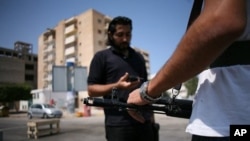
The Moammar Gadhafi government in Libya has collapsed after 42 years, and many people question whether Tripoli will descend into the chaos that plagued Baghdad after the fall of Iraq's Saddam Hussein. An answer may be found in neighborhood checkpoints.
“You are Americans? Nice to meet you. Nice to meet you.”
We meet Mohammed Abou Gabha manning a checkpoint on a central Tripoli street.
Mohammed, a 21-year-old pilot trainee, grew up on Zawiya Street.
For the past week, he and his lifelong neighbor, Mohammed Badi, a student of French, have been manning a checkpoint, stopping cars and trucks traveling through the neighborhood.
“We need to be safe here, because we know mafias, Gadhafi’s mafias...,” Abou Gabha says.
This checkpoint, multiplied by the thousands across this sprawling city of 1.5 million people, helps explain why Tripoli has suffered only small-scale looting since the sudden collapse of the Gadhafi government.
Pausing from checking cars, Abou Gabha explains the checkpoints did not spring up by accident.
Since May, underground military councils formed neighborhood by neighborhood.
“If Gadhafi's government know we have a council here, they will kill us, and catch us, and put us in prison,” says Gabha.
Critics say the city is awash with guns. Mohammed says the guns at his checkpoint are strictly controlled by his neighborhood military council.
“They count it...and if I shoot one, I will be in trouble,” he says.
Mohammed Badi grew up across the street from Mohammed Abou Gabha.
“I trust him too much. If I do not trust him, I do not give him my back," says Badi. "He has a gun. We do not like guns very much in Libya.”
One week after Tripoli’s uprising, as the city returns to normal, there is no evidence of looting on Zawiya Street. The key, Mohammed Abou Gabha says, is neighborhood unity. Referring to the multi-story apartment buildings on his street, he says, “All the buildings, we are just like one man.”
Later, I encounter Mohammed down the street, directing traffic in front of the neighborhood mosque.
“This car and this guy is coming from Misrata. And there's another guy is coming from Benghazi also," says Gabha. "That means we are one country. We live one country.”
With luck, the unity displayed on the block level here in Tripoli, will play large in Libya, allowing for a new government of national unity.
Scenes from Tripoli: