



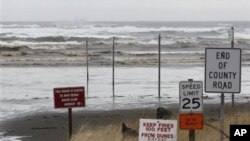
Emergency officials in Hawaii and on the US West Coast are assessing damage from the Japanese tsunami, which sent waves racing across the Pacific early Friday. The impact was less severe than many had feared, but several coastal communities experienced damage.
The magnitude 8.9 earthquake triggered a tsunami with waves as high as seven meters, devastating parts of the northeastern coast of Japan. The waves had diminished by the time they reached Hawaii and later washed up on North American shores.
The US Coast Guard reports that it was searching for a man in Northern California who was washed out to sea while taking photographs. Four other people were rescued.
Lucy Jones of the United States Geological Survey says that up and down the coast, the waters were turbulent even though the waves were not high. "And in all of these places, the currents, not just the depth of the water, are very significant issues. There's a lot of force pushing that water around the Pacific."
Kate Long of the California Emergency Management Agency said docks and boats were damaged at Crescent City in Northern California. "We learned that Crescent City has so far had 2.48 meters of waves above normal tide line, that the harbor is significantly damaged or destroyed."
|
VOA's Kate Woodsome's Q&A with Bill Dorman of Hawaii Public Radio:
|
A dock was destroyed and boats slipped out of their moorings, some of them capsizing, at the port of Santa Cruz, California.
Some coastal communities were evacuated in central California and regions northward. Beaches were closed around Los Angeles, but the tsunami's impact was limited, partly because the waves arrived at low tide in the morning.
An advisor to the U.S. Geological Survey told reporters in Washington that the Japanese quake ruptured a section of the earth's crust 240 kilometers by 80 kilometers, and was the largest quake in the region for 1,200 years.
The earthquake occurred along a subduction zone, where two of earth's geological plates meet and one pushes suddenly under the other. Displaced water in the ocean causes the tsunami.
Thomas Heaton, a seismologist at the California Institute of Technology, expects a similar large quake along a subduction zone in northwestern North America, at some point in the future. He said the Japanese quake will provide important data.
"This is really unexplored territory. So to have an earthquake of this nature that is so well recorded both by scientific instruments and also by the buildings that are in place will have very important information for us about our hazards in Northern California, Oregon, Washington, British Columbia area," said Heaton.
In Los Angeles, an urban search and rescue team made up of firefighters, physicians, engineers and other specialists is preparing to head to Japan to help in the search for survivors.