


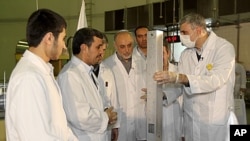
Senior United Nations nuclear inspectors have arrived in Tehran for two days of talks on Iran's disputed nuclear program, the second U.N. visit in three weeks.
Iran's state radio said Monday the delegation from the International Atomic Energy Agency hopes to meet Iranian nuclear scientists and visit the Parchin complex, an Iranian military base and conventional weapons development facility outside of Tehran.
The site has been suspected of housing a secret underground facility used for Iran's nuclear program, a claim denied by Iranian authorities. Iran says its nuclear ambitions are peaceful.
The IAEA team is led by chief nuclear inspector Herman Nackaerts, who said his top priority is analyzing the "possible military dimensions of Iran's nuclear program." He said the group wants to see "concrete results" from two days of talks with Iranian officials, but cautioned that progress may take time.
The U.N. inspectors want Iran to explain the findings of a recent IAEA report that cited evidence of Iranian work on the design of a nuclear weapon. Iran says the report is based on fabrications.
The IAEA visit comes a day after the top U.S. military officer, General Martin Dempsey, said an Israeli strike on Iran's nuclear facilities would be "premature" because it is unclear that Iran would assemble a nuclear bomb.
Israel says military action may be needed to prevent Iran from acquiring nuclear weapons.
Also Monday, the head of Iran's state oil company threatened to cut crude exports to more European Union nations, a day after limited sales were halted to France and Britain.
Iran's semi-official Mehr news agency quotes Ahmad Qalehbani as saying exports to Spain, Greece, Italy, Portugal and the Netherlands may be stopped if they continue "hostile acts" against Iran.
The United States, Israel and other nations accuse Iran of trying to develop nuclear weapons under cover of a civilian energy program. Iran says its atomic program is for peaceful purposes.
Some information for this report was provided by AP, AFP and Reuters.
| Join the conversation on our social journalism site - Middle East Voices. Follow our Middle East reports on Twitter and discuss them on our Facebook page. |