



Health authorities in Germany blame bean, alfalfa and other raw sprouts for the unprecedented outbreak of E. coli bacteria poisonings that are blamed for the deaths of 36 people and illness to 3,000 others. Sprouts can be difficult to grow safely, and raw sprouts have been linked to a number of disease outbreaks over the years. In the United States, another risky food is gaining in popularity - raw milk.
It is late afternoon at Hedgebrook Farm, about an hour and a half from Washington, and the cows are heading for the milking parlor.
Hedgebrook is one of the few places in the area where you can get raw, unpasteurized milk straight from the cow.
Customer Anna Elrod says at first, she bought it for her son’s health. “My son’s eczema cleared up completely, he never had another ear infection and the milk tastes so much better that I’ll never go back to store milk. Never,” she said.
Raw milk has a devoted following, a fact that baffles food safety advocate Sarah Klein at the Center for Science in the Public Interest. “There are absolutely no scientifically proven benefits to drinking raw milk, and there are well-documented risks,” Klein said.
Such as E. coli, salmonella and other bacterial diseases that milk can carry. Pasteurized milk is heated to temperatures that reduce the number of germs, then cooled and bottled. Raw milk drinkers say it also kills the good things in milk. But Klein says it's not worth the risk.
“We went from 25 percent of our food and waterborne outbreaks being linked to dairy products to under 1 percent with the advent of pasteurization,” she said.
For that reason, it is illegal in many states to sell unpasteurized milk.
But a recent crackdown on a farmer carrying raw milk across state lines drew demonstrators to Washington this spring.
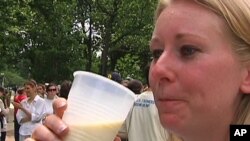
They even brought a cow and milked it on the spot. And drank the raw milk in protest.
Some have found a way around the ban on buying raw milk. They share a cow. Anna Elrod explains. “I’m not buying milk. I’m buying part of a cow. I own that cow,” Elrod said.
Hedgebrook Farm sells 25 shares of each cow, providing each part owner with about four liters of milk a week.
Kitty Hockman-Nicholas and her family own Hedgebrook. She says the farm's raw milk is perfectly safe. “Pasteurization started out because there was a need, because of the uncleanliness that we had in the 1700s. But now, all that has changed,” she said.
Hockman-Nicholas says methods have improved since then. She says her dairy is inspected regularly and receives high marks.
But many health experts say bad things sometimes happen even at good dairies, and contamination from dirt, manure and insects can easily find its way into raw milk. Again, food safety advocate Sarah Klein.
“The United States has enjoyed safe milk for many decades now, and unfortunately many consumers are turning back to a time when milk wasn’t a safe product to drink. It’s ironic,” Klein said.
But raw milk’s backers say they will continue to fight for the right to drink milk straight from the cow.