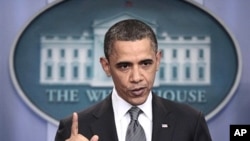
The White House says a budget meeting between President Barack Obama and congressional leaders is "still possible" Wednesday, as the deadline to avoid a government shutdown looms.
The U.S. government has been operating with a series of stopgap funding measures since the start of the 2011 fiscal year October 1. The current funding for the federal government runs out after Friday.
President Obama held talks at the White House Tuesday with the top Republican in the House of Representatives, John Boehner, and Senate Majority Leader Harry Reid, a Democrat.
Afterward, the president told reporters it would be "inexcusable" if Republicans and Democrats fail to achieve a compromise on their budget demands. Failure to agree on a budget by the end of the week would force many government agencies and services deemed non-essential to be halted starting Saturday.
After the White House meeting, Boehner and Reid met again, privately, at the U.S. Capitol to try to craft a plan that could win enough votes to be approved by Congress.
Obama said he is opposed to another stopgap spending extension, unless the lawmakers reached essential agreement and needed a very short time to finish passage of the budget.
The president said an agreement is needed to avoid jeopardizing the country's economic recovery. Republicans say they do not want a shutdown, but that sharp spending cuts must be enacted to help cut the government's deficit.
The White House and congressional leaders have been trying to cut at least $33 billion from the $1 trillion-plus discretionary part of the U.S. government's budget.
But Tea Party supporters among the Republican majority in the House of Representatives have been seeking broader cuts. Boehner said Republican negotiators would continue to "fight for the largest [spending] cuts possible."
US Budget Talks to Continue as Possible Government Shutdown Looms