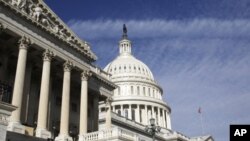



A U.S. congressional panel has examined the threat posed to U.S. national security by the current unrest in a number of countries in North Africa and the Middle East. Several security experts told a House Homeland Security subcommittee Wednesday that the al-Qaida terrorist group and its affiliates have been "irrelevant" in the wave of popular uprisings in the region, and that the United States needs to back the young people who are taking to the streets for democratic change.
The Chairman of the Counterterrorism and Intelligence Subcommittee, Republican Congressman Patrick Meehan of Pennsylvania said he welcomes the positive changes in Egypt and Tunisia, but he is worried that the unrest across the Middle East and North Africa could have ramifications for U.S. homeland security. He said there were credible reports from Egypt, for example, that prisons were emptied and that a number of jailed Islamist radicals are now free.
"Quite simply hundreds of radicalized Islamists on the loose throughout the Middle East and North Africa is dangerous," Meehan said.
The ranking member of the panel, Democratic Congresswoman Jackie Speier of California said that it is time for the United States to re-evaluate its long-standing relationships in the region, pointing out that Egypt and Tunisia have disbanded their long-feared state security forces.
"For the first time in decades, relationships that we have relied on in the fight against terrorism are changing," she said. "And in some cases we have to work with new partners who will not necessarily respect past security agreements and practices."
Speier said that the United States must learn more about who the rebels in Libya are, but she also stressed that Washington must make sure it supports the democratic ambitions of the people in the region.
All of the experts testifying at the hearing agreed that the United States has long supported goverments in the Middle East that appeared stable and friendly to U.S. interests, but were undemocratic.
Brian Katulis, a Senior Fellow with the Center for American Progress research group, put it like this.
"For decades we have been addicted to dictators," he said. "And it is like our addiction to foreign oil that a lot of people talk about. We know it is bad for us, we know we need to move beyond it, we simply have not yet figured out how to move beyond it."
Katulis said the wave of unrest presents an opportunity for the United States to embrace a new generation of leaders, and that they should not be overly concerned about the influence of al-Qaida. Katulis and the other experts at the hearing agreed that up until now, al-Qaida has not played a real role in the wave of protests.
"Al-Qaida to date has been irrelevant in the popular uprisings and has been left behind," he said.
Philip Mudd of the New America Foundation said he believes al-Qaida has been hurt badly since their successful September 11th, 2001 attacks on the United States. He said they hurt themselves by killing two many innocents. And he said, if dictators continue to fall in North Africa and the Middle East, al-Qaida will lose the powerful recruiting tool of asking young people to join to fight scorrupt governments. Mudd said the United States should engage with and provide aid to the new governments emerging in the Middle East and North Africa as long as they embrace non-violence and the rule of law.
US Congressional Panel Examines Terrorism Threat Posed by Libya, Mideast Unrest