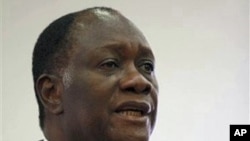



The U.S. ambassador to the Ivory Coast said Friday international pressure on defeated Ivory Coast President Laurent Gbagbo is mounting, and that the "window" for his peaceful departure is closing. U.S. envoy Phillip Carter says the Obama administration is considering additional sanctions on Mr. Gbagbo.
The standoff between Mr. Gbagbo and the internationally recognized winner of the Ivory Coast election, Alassane Ouattara, has dragged on for more than two months, despite sanctions against the defeated leader and key associates.
But the U.S. Ivory Coast ambassador, Phillip Carter, says Mr. Gbagbo cannot expect to withstand mounting international political and economic pressure to step aside over the long-term.
The Ivory Coast envoy, in Washington for a global meeting of U.S. ambassadors, says mediators from the African Union and West African regional grouping ECOWAS want to resolve the conflict within a month, and that time for a graceful departure by Mr. Gbagbo is dwindling.
"I think the Africans are looking for whatever means they can to avoid conflict," said Carter. "They all recognize that the human rights abuses that are occurring in Abidjan and the western part of the country are something that has to be attended to. And the question of accountability is coming up. And so that window for Gbagbo to leave honorably, peacefully, with amnesty - that window’s closing."
U.S. envoy Carter said Mr. Gbagbo, facing international economic sanctions, has been resorting to extortion tactics against local companies to meet the payroll for security forces, who he said might turn against him if the money runs out.
Mr. Ouattara has been largely confined to an Abidjan hotel since the November 28th run-off election, under guard by African Union peacekeepers and French troops.
But U.S. envoy Carter said Mr. Gbagbo, whom he described as a "pretender" to power, is no less isolated.
"I would submit that they’re both isolated: Gbagbo within his own presidential palace with his cohorts around him, increasingly isolated within the international community financially, politically, economically," he said. "Whereas Ouattara, though he’s physically isolated at the Gulf hotel, has the support of virtually the entire international community and financial system."
Carter says U.N. officials have attributed 250 summary executions and 100 disappearances of Ouattara supporters to security forces loyal to Mr. Gbagbo, and warned those numbers will likely climb if what he termed the current "stasis" in the country continues.
He said the Obama administration is considering the expansion of the targeted travel and financial sanctions it has imposed against Mr. Gbagbo, his wife and key aides in coordination with the European Union.
US Envoy Says Time Running Out for Peaceful Departure for Ivory Coast’s Gbagbo