



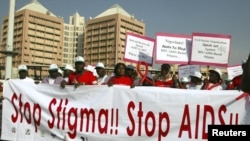
An independent panel of U.S. health experts is recommending that all Americans between the ages of 15 and 65 be routinely screened for HIV, the virus that causes AIDS. The HIV test would not be mandatory. But experts hope more widespread testing might reduce some of the stigma attached to getting screened for the sexually transmitted disease. And they believe it could lead to earlier treatment for those who test positive for HIV, and further slow the spread of this potentially lethal infection.
According to the U.S. Centers for Disease Control and Prevention, an estimated 1.2 million Americans are living with the AIDS virus and every year, the number of HIV-infected individuals increases by about 45,000. Public health specialists say that about 25 percent of infected people do not know they are carrying the virus.
The U.S. Preventive Services Task Force, a government-backed advisory panel made up of 16 doctors and scientists, is urging that everyone between 15 and 65 years of age be offered an HIV test.
Carlos Del Rio, who is not a member of the health panel, is co-director of the Emory Center for AIDS Research in Atlanta, Georgia. He says early screening is important for two reasons:
“People [who undergo screening] are less likely to progress to disease and, as importantly, are people who are less likely to transmit to others. So starting therapy early leads to better disease outcomes," said Del Rio.
Experts say early detection - when patients' immune systems are still relatively intact - increases the odds that they will live longer and not spread the virus to others.
In 2005, the Task Force had recommended HIV testing for adults at high risk for becoming infected, including those who had unprotected sex with multiple partners and those who were intravenous drug abusers. Now, for the first time, Del Rio says, the HIV test would be offered as an early screening tool rather than a diagnostic test late in the disease process when patients go to their doctors with a list of health complaints.
As with any other screening test, Del Rio says this one would be voluntary.
“So if you don’t want to be tested, you don’t need to be tested. I mean if I go to my clinician [and he] says, hey, you know the U.S. Preventive Services Task Force suggests we get an HIV testing, and I say I really don’t want that, you don’t need to get it," he said. "This is not ordering mandatory testing, right?"
Before making their new screening recommendation, the task force members agreed that the tests have to be accurate, treatment for the AIDS virus must be readily available and, importantly, the benefits of testing must outweigh any harm to those taking the test.
A description of the voluntary HIV testing recommendation is published in The Annals of Internal Medicine.
According to the U.S. Centers for Disease Control and Prevention, an estimated 1.2 million Americans are living with the AIDS virus and every year, the number of HIV-infected individuals increases by about 45,000. Public health specialists say that about 25 percent of infected people do not know they are carrying the virus.
The U.S. Preventive Services Task Force, a government-backed advisory panel made up of 16 doctors and scientists, is urging that everyone between 15 and 65 years of age be offered an HIV test.
Carlos Del Rio, who is not a member of the health panel, is co-director of the Emory Center for AIDS Research in Atlanta, Georgia. He says early screening is important for two reasons:
“People [who undergo screening] are less likely to progress to disease and, as importantly, are people who are less likely to transmit to others. So starting therapy early leads to better disease outcomes," said Del Rio.
Experts say early detection - when patients' immune systems are still relatively intact - increases the odds that they will live longer and not spread the virus to others.
In 2005, the Task Force had recommended HIV testing for adults at high risk for becoming infected, including those who had unprotected sex with multiple partners and those who were intravenous drug abusers. Now, for the first time, Del Rio says, the HIV test would be offered as an early screening tool rather than a diagnostic test late in the disease process when patients go to their doctors with a list of health complaints.
As with any other screening test, Del Rio says this one would be voluntary.
“So if you don’t want to be tested, you don’t need to be tested. I mean if I go to my clinician [and he] says, hey, you know the U.S. Preventive Services Task Force suggests we get an HIV testing, and I say I really don’t want that, you don’t need to get it," he said. "This is not ordering mandatory testing, right?"
Before making their new screening recommendation, the task force members agreed that the tests have to be accurate, treatment for the AIDS virus must be readily available and, importantly, the benefits of testing must outweigh any harm to those taking the test.
A description of the voluntary HIV testing recommendation is published in The Annals of Internal Medicine.