


The United States on Thursday characterized its first day of exploratory talks with North Korea as “serious and business-like.” The two days of meetings are aimed at determining whether Pyongyang is willing to resume negotiations over its nuclear program. The talks are the highest-level meeting between the two countries since a visit to North Korea by a senior U.S. envoy nearly two years ago.
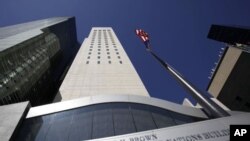
The closed-door meeting was held in the shadow of the United Nations - at the U.S. Mission.
U.S. Special Envoy for North Korea Stephen Bosworth greeted the head of the North Korean delegation, Vice Foreign Minister Kim Kae-gwan, with a handshake when he arrived in the morning. Then they disappeared into the concrete tower until Mr. Kim emerged at midday for a lunch break.
The North Korean official traveled by car the short distance around the corner to his hotel, perhaps to avoid the throng of mostly Asian reporters and cameramen waiting for him outside the U.S. Mission. But he was unsuccessful. At his hotel, more reporters awaited him.
Kim stopped briefly to respond to their questions about the talks, saying, "the atmosphere was good" and that the meeting was "constructive and interesting." with an exchange of views on general issues.
At the State Department in Washington, Deputy Spokesman Mark Toner said the United States will use the talks, which it characterizes as “exploratory,” to determine whether North Korea is serious about fulfilling its nuclear obligations, including ending its nuclear program.
“There was the meeting in Bali between North and South Korea," said Toner. "It was constructive. Now we have embarked on these exploratory discussions. We are quite clear broadly what we are looking for, which is for North Korea to live up to its commitments in the 2005 joint statement as well as its international obligations. And it needs to take concrete steps toward denuclearization.”
In exchange for North Korea meeting its obligations, the United States, China, South Korea, Japan and Russia - all members of the Six-Party Talks - would offer Pyongyang food and energy assistance as well as diplomatic incentives.
North Korea pulled out of the Six-Party Talks in April 2009 after the U.N. Security Council condemned Pyongyang's launch of a long-range rocket, in violation of a council resolution.
Relations on the Korean Peninsula deteriorated further last year, after North Korea was accused of sinking a South Korean warship and shelling a South Korean island.
Thursday’s meeting between the United States and North Korea continued into the afternoon. Afterward, the United States said in a statement that the discussions were “serious and business-like” and that it looks forward to continuing the talks on Friday.
US, North Korea Begin Exploratory Nuclear Talks