



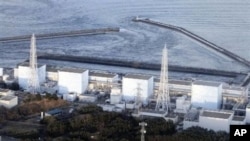
Tens of thousands of residents near a nuclear plant in Japan were evacuated Saturday after an explosion at the plant, 240 kilometers north of Tokyo. The reactor failure follows a devastating earthquake and tsunami that struck northeastern Japan on Friday.
Japanese officials have reassured the public, saying there is no danger of a meltdown of the reactor core. But US nuclear experts say they are worried about the possibility.
The failure at the plant in Fukushima Prefecture was caused by a power loss, and then a loss of backup power, following the massive earthquake and tsunami Friday.
A Japanese official said a buildup of hydrogen in the reactor's cooling system caused the explosion, but he said the containment structure was intact. Radiation was released, but government officials say the levels were low and are dropping.
Watch the explosion at reactor number one in Fukushima
Saturday, residents within 20 kilometers of the plant were evacuated, while government officials said there is no danger of a melt-down and large-scale radiation release, like the one at Chernobyl, Ukraine, in 1986 that sent radioactive clouds billowing across Europe.
The four American experts and a colleague in Japan briefed reporters by telephone Saturday, and they said they were less certain.
Nuclear energy analyst Robert Alvarez of the Institute for Policy Studies says there are many things we do not know about the failure, including whether the containment structure is fully intact. "The information that has been made public, particularly by the Japanese nuclear safety authorities, certainly indicate that radioactive elements from the fuel itself have escaped and entered the environment. And even if the reactor maintains its integrity, there's a possibility that things like open relief valves on the top of the reactor and things like that may still release large amounts of radioactivity," he said.
Ken Bergeron, a physicist who formerly worked for Sandia National Laboratories, says a so-called station blackout - which involves the loss of both off-site electricity and on-site backup power from diesel generators - is viewed in the nuclear industry as extremely unlikely. But he says it happened.
"So we're in uncharted territory. We're in the land where probability says we shouldn't be. And we're hoping that all of the barriers to release of radioactivity will not fail," he said.
He said the first barrier, the so-called fuel cladding that covers the reactor rods, has apparently failed, which he says is shown by the release of radiation into the atmosphere.
Crews are pumping a mixture of seawater and boron to cool the reactor, and these experts say it is essential to keep the water flowing for several days. Analyst Alvarez called the use of seawater a "Hail Mary pass", a term from American football meaning an act of desperation. But he said that with enough water pumped at sufficient volume and rate, the reactor can be stabilized.
Ken Bergeron said it is also crucial to restore electric power in order to pump enough water.
Ira Helfand of the group Physicians for Social Responsibility says the reactor contains huge levels of radioactivity that cannot be allowed to escape. "The bottom line is that we just don't know what's going to happen over the next couple of days. And frankly, neither do the people who are operating these power plants. They're very complex systems that are clearly way out of whack, and whether they're going to be able to contain the radiation inside the reactors or not, is simply not known at this point," he said.
Japanese health officials have announced they will distribute iodine tablets as a precaution. Iodine is know to protect against radiation-induced thyroid cancer.