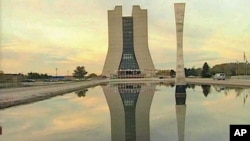
A 26-year search for the keys to understanding the universe has come to an end at the U.S. Department of Energy’s Fermilab in suburban Chicago. The Tevatron Accelerator, one of the world's largest sub-atomic particle colliders, went offline permanently Friday. The Large Hadron Collider, or LHC, near Geneva, Switzerland, will take over one of the Tevatron's most important projects, tracking down the so-called “God Particle.”
For more than 15 years, physicist Robert Roser has searched for the elusive “Higgs Boson.”
“The Higgs Boson is a hypothetical particle that we believe exists to fix a flaw in the standard model," said Roser. "The standard model, to us, is our mathematical description of how the universe works. The significant flaw in that model is that it doesn’t explain mass.”
Roser says the discovery of the Higgs Boson - known to many as the “God Particle” - could give scientists the answers they seek to some of humankind's biggest questions.
“We’re asking the question of how the universe works, and why is it built the way it is built?" he said.
To find the Higgs Boson at Fermilab, scientists have used the Tevatron's 6.5 - kilometer - long ring to slam protons and anti-protons together at near-light speeds. In the burst of superheated particles that resulted, scientists looked for clues that the Higgs Boson exists.
That elusive particle has not yet been found. But since 1985, the Tevatron has made thousands of major discoveries, and in 1995 found one of the most fundamental bits of matter in the universe, known as the "top quark."
Still, past triumphs could not save the Tevatron from the reality of rising research costs and tighter budgets:
“All good things will come to an end, and this will be the end for the Tevatron," said Pier Oddone.
Pier Oddone is the Director of Fermilab. He says the funding needed to continue the kind of research that would lead to the Higgs Boson, if it exists at all, exceeds Fermilab’s $400 million annual budget.
“It is one third the budget of the laboratory in Geneva, Switzerland," he said.
The CERN laboratory in Geneva is home to the Large Hadron Collider. Built in collaboration with Fermilab, it is a more powerful device than the Tevatron Accelerator. With the Tevatron offline, the center of activity in this area of physics moves from the United States to Europe.
“In this last two decades that has shifted where the facility in Geneva went ahead and built this formidable machine, which we were trying to build in Texas called the Superconducting Supercollider," said Oddone. " We closed ours but the Europeans went ahead with theirs, and that is what has led to this differentiation now in the funding of laboratories.”
But even without the Tevatron, the U.S. is still well-represented in the field of particle physics. Since the Tevatron began colliding, Fermilab scientist Robert Roser says it has been an international effort, and that effort will continue as the search goes on in Geneva.
“There’s 15 nations that are participating on this experiment," he said. "Roughly 300 of the 600 collaborators on this experiment are from non-U.S. institutions. So it’s very much a large multi-national or international collaboration. All big science is these days.”
Even offline, the Tevatron will continue to play a role at Fermilab. Engineers plan to open previously inaccessible parts of the collider tunnel, where they will display part of the accelerator and detectors in an exhibit the public can visit.