



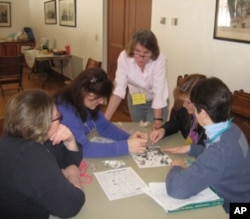
When it comes to making science fun, Lisa Purcell is a pro. Mimicking an owl or a foraging squirrel is all in a day's work for the director of the Four Winds Nature Institute. On this particular morning, she’s training volunteers from three Vermont towns, Shrewsbury, Chittenden and Mendon to teach an elementary school workshop on owls.
Purcell and several colleagues founded the Four Winds Nature Institute in 2006. Their school workshops are modeled after a similar program created back in the 1970s by the Vermont Institute of Natural Science.
Community-based science education
Purcell worked for VINS for years as a science educator. But, she says, as VINS focused more of its energy on building its new headquarters, Purcell and others spun off Four Winds to ensure that the community-based science education program remained strong.
That's especially critical at a time when American teachers are under increasing pressure to fit more standardized instruction into their school day. Science educators say that, too often, the hands-on study of natural sciences can get short-changed.
Creative approach
Four Winds currently has 1,500 volunteers working in four northeastern states. Shrewsbury resident Connie Youngstrom is one of them.
“We’ve had visits to the stream in the back of our school. Kids always get soaking wet but they love it. Their eyes light up when they get into the stream and turn over rocks to find little crustaceans and little critters under the stones.”
The program’s curriculum is designed to comply with the state of Vermont’s science standards. Four Winds charges schools $3,200 to participate. That pays for eight volunteer training sessions and the accompanying teaching materials. Staffers work hard to make the material relevant.
“We know that we want kids to be learning hands on and make discoveries in their own backyard. We’d love it to be something that they’ve walked by for years without noticing it," says Purcell. "And then we start thinking about how we’ll get kids excited about that. What will the puppet show need to include for students to understand the life of a goldenrod gallfly, for example?”
Kelli Bates, a teacher at Barstow Memorial School in Chittenden, says that creative approach is what makes Four Winds so popular with students.
“One year we were doing something with trees and the kids were actually parts of the tree - some would be the trunk and kids were actually laying on the floor being the roots - and things like that just connect these science theories in a way that they can understand.”
Hands-on science
Four Winds director Purcell not only trains volunteers, she is one. One afternoon a month, she puts her organization’s science activities to the test in front of first graders.
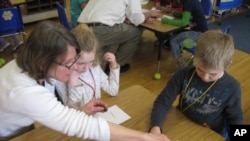
Purcell explains to the six- and seven-year-olds how owls eat things whole and then cough up pellets filled with what they couldn’t digest. She passes out pellets - which are sanitized and purchased from Owlpellets.com - for the students to examine.
“We’re just very carefully pulling these apart because we’re collecting data," she explains to the students. "We’re collecting information on what the owl ate."
At first, some of the young scientists are hesitant. But within minutes, they’re riveted. Seven-year-olds Gracie Stahura and Sophia Husack lean over their prize - the tiny skeletal remains of a tiny rodent called a vole.
“Do you see those teeth? It’s so cool. I never knew about the pellets. We have a big yard and there’s woods all around us and I’m going to look under the trees - so if I find them I’m going to get some toothpicks and open it.”
Purcell looks over at the girls’ table and beams. Her young students are excited by their scientific discoveries. Mission accomplished.