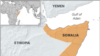



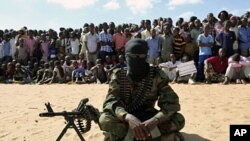
Somalia's Islamist militant group al-Shabab is fighting on multiple fronts against Kenya, Ethiopian and African Union forces. But their toughest battle may be against their own mothers, brothers and friends who are pleading with them to surrender for the sake of peace.
Abdirahman Hassan, 21, is part of the Ras Kamboni militia, a group allied to Somali government forces in the fight against al-Shabab. Right now he is on assignment protecting the town of Dobley, just across the border from Kenya.
His brother Jamaa, 18, is fighting for al-Shabab and is stationed in Afmadow, a town less than 10 kilometers from the frontline of the war.
Hassan says whenever he talks to his brother he always advises him to leave the terror group. He says, in turn, his brother tries to convince him to join al-Shabab.
“We do call each other. I do tell him there is no reason to stay with al-Shabab and he should leave the group, since they have also allied with al-Qaida," said Hassan. "And he says I am a non-believer and that I have to leave whatever I am doing and to join him.”
Hassan also said if he meets his brother in the battle he is aware that neither sibling will spare the other.
“When we meet, a gun will separate us, every one of us trusts and believes his gun," Hassan said. "If we come face to face with him in the battle field, I will kill him, it’s a must, and if he gets the same chance he will kill me too because he has been told that by killing your enemy you will go to heaven.”
Al-Shabab-al-Qaida ties
Al-Shabab, a name which means “The Youth,” recently formalized its ties with al-Qaida, and has been fighting to impose its harsh version of Islamic law in Somalia. Some of the group's top leaders are foreign militants who have come to Somalia for what they call a jihad, or holy war.
But Muslim clerics in the region have often said there is no jihad in Somalia, but only a group of people who are fighting over territory and resources.
Somali government fighter Sultan Hamdi said his nephew is fighting for al-Shabab and is stationed in Beledweyne, in Somalia’s Hiraan region. According to Hamdi, his nephew joined al-Shabab at the age of 15 when the militants recruited his entire school class.
“These children are brainwashed and al-Shabab are taking this young generation to fight for them. We are just praying he sees the right path. I have also told him if that we meet in the battle field, and if he fires at me and my colleagues, I will fire at him, there will be nothing like uncle and nephew. Can you show mercy to someone who wants to kill you?”
Recruiting minors to replenish ranks
With al-Shabab's ranks dwindling, due to tension and in-fighting within the group, human rights organizations say the militants have increasingly recruited children to strengthen their numbers. Families and children that resist the recruitment drive face severe consequences and even death.
Ras Kamboni spokesman Abdinassir Serar says he knows some of his troops speak to their family members in al-Shabab. He says some have successfully convinced their loved ones to leave the group.
“First of all these people have joined al-Shabab not knowing what they are getting into. As you are aware, they also recruit young children," Serar said. "Lack of that maturity is a problem. But when someone else, be it a parent or a relative or a friend, is able to advise them, it’s possible for some of them to accept the advise and look for ways to get out of the situation they are in.”
A good number of al-Shabab fighters have contacts within the government and are able to surrender easily in exchange for safe passage.
But Serar says there are others who surrender out of fear, knowing they have become everyone's enemy in and out of the country.
Hassan, of Ras Kamboni, says for those who do not have contacts in the government, all they can do is go to the bushes, bury their weapons and come back to their civilian lives.