



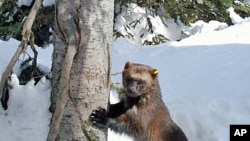
One of the rarest mammals in North America is staging a comeback in the mainland United States. Wildlife biologists have tracked wolverines on mountainsides where they haven’t been seen in many decades. But several new studies suggest the recovery could be short-lived if the animals’ mountain snowline habitat continues to retreat due to global warming.
If you’re willing to settle for a mascot, the legendary wolverine is easy to find in the USA. It’s the namesake of countless high schools, a bunch of colleges and several American university sports teams. But if you want to see an actual wolverine in the wild, good luck. Despite the fact that the brown, shaggy carnivores are among the largest members of the weasel family and reach weights up to 15 kilograms, these stocky scavengers are extremely elusive. The biologists who study them rely on radio tracking technology and aircraft or snowmobiles to improve the odds of finding their quarry.
John Rohrer, a district biologist for the Okanagan-Wenatchee National Forest, also uses dead deer heads to lure elusive wolverines. "They’re in this winter environment that we think is so harsh and so inhospitable, and they’re loving it."
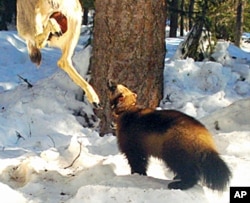
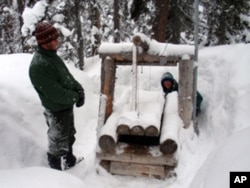
Rohrer, Scott Fitkin and company have set up 11 live capture traps in the high country east of the Cascade Crest. Both men have worked with all sorts of interesting critters, but hold a special reverence for the wolverine.
"These are the most charismatic animals I’ve worked with over 20 years in my career," says Fitkin. "They have a lot of personality. They’re certainly individuals. Each one is a little different in the way they react to us. They’re a very beautiful animal. Everything about them is just interesting."
They’re also really rare. Trapping and deliberate poisoning more or less wiped out the wolverine from the contiguous United States. But now wolverines have moved down from Canada to reoccupy their historic ranges.
This is the sixth season Rohrer and Fitkin have pursued the elusive scavengers. Captures are rare. Fitkin videotaped the most recent one of a wolverine they named Rocky.
When the field crew catches a wolverine, they attach a GPS tracking collar and set the animal free again. Study leader Keith Aubry can monitor the signals from his desk at the Forest Service’s Pacific Northwest Research Station in Olympia.
Aubry says the wolverine’s rebound appears fragile. "The populations are not dense and they’re not reproducing rapidly. So it’s a precarious situation."
Aubry, who is working on a science journal paper on the topic, believes global warming poses the biggest threat to wolverines because the animals need long-lasting snow cover to dig the snow caves in which they give birth.
"The denning period, weaning, occurs about in mid-May," he says. "They need snow cover that persists to mid-May to provide these dens for the kids. If snow starts melting early, the den could start collapsing."
The Forest Service is funding a parallel study in central Idaho. But in Idaho, the wolverines aren’t the only ones being tracked. The research team led by biologist Kim Heinemeyer is asking snowmobilers and backcountry skiers to voluntarily carry GPS tracking units, too. That lets Heinemeyer see whether human recreation affects the wolverines.
"It’s a very complicated question that we’re trying to answer," says Heinemeyer. "While we have resident animals in the landscape and some of them have successfully denned we believe, we don’t know the potentially more subtle interactions that may happen between winter recreation and wolverines."
In December, the U.S. Fish and Wildlife Service classified wolverines as a candidate for endangered species protection. This was in response to several conservation groups who petitioned the service to have the wolverine listed as threatened or endangered. The federal agency agreed with the petitioners that climate change poses a long-term threat to the animal’s survival in the contiguous U.S. But officials say full endangered species protection for the wolverine is "precluded" right now by the need to direct resources to higher-priority cases.