



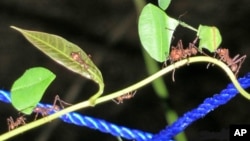
Ants in the Panamanian rain forest could inspire high-tech tools of the future that are strong and can withstand fracture. During the course of his work, University of Oregon research scientist Robert Schofield also discovered that when the ants are no longer capable of doing their job, nature takes care of these displaced workers.
Leaf-cutter ants have powerful blades on either side of their head. These mandibles as sharp as any man-made knife, but wear out over time, according to University of Oregon research scientist Robert Schofield.
"It is stuck with one knife for its whole life," he says.
Schofield built a tiny machine that could cut using blades removed from the ants and found that the colony spends twice as much energy cutting leaves as it would if all ants had sharp mandibles.
Schofield says ants with dull blades cut slower and are less efficient on the job, harming the colony's ability to sustain itself. So they stop cutting leaves but they don't stop working. A single colony can harbor as many as five million ants, all specialized workers. Some are soldiers, others nurse the young and grow the food. Still others forage for leaves and carry the leaves to the nest. Those leaves are chewed up to provide a nutrient bed for growing an edible fungus, which is the main food source for the colony.
When Schofield compared the blades of ant cutters with ant carriers he discovered that once the mandibles wore down, the cutter ants changed jobs. "And, of course, if they were solitary when they could no longer cut, that would be the end of their lives, but since they are social insects, when they no longer cut, they can rely on their sisters and they can do other work that's beneficial to the colony. They can carry the cuttings back to the nest."
Schofield says analysis of the mandibles could help in development of new high-tech materials and tools. "For instance, up to 25 percent of the material in their blades is zinc. And we suspect that this bio-material helps prevent fracture, that it maintains a sharp blade without the blade fracturing."
Schofield adds that understanding the insect's weakness could help farmers fight against leaf cutter infestations. "We've shown here in this paper that they are very sensitive to wear and so one might guess that crops that produce more wear because there were more abrasives in them, that there might be more resistance to these cutter ants."
Robert Schofield sums up his findings in the title of his study: "Leaf-cutter ants with worn mandibles cut half as fast, spend twice the energy, and tend to carry instead of cut." It appears on line in advance of its publication in the Journal Behavioral Ecology and Sociobiology.