



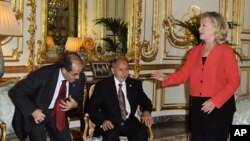
Representatives from 60 countries have gathered in Paris to discuss a Libya without Moammar Gadhafi while the former leader vowed that he would not give up the fight.
Officials in Paris expect National Transitional Council (NTC) leader Mustafa Abdel Jalil to outline an 18-month process leading to a new constitution and elections. Before the meeting got under way, British Foreign Secretary William Hague told journalists that the provisional authority group in Libya had begun the process of creating a "democratic" and "inclusive" country.
Meanwhile, Gadhafi said his forces would not surrender and would ultimately be rewarded with victory. His audio statement was carried by Arabic television stations on Thursday.
Gadhafi's whereabouts are still unknown.
Earlier Thursday, Libya's provisional authorities gave loyalists in his hometown of Sirte an additional week to surrender. The NTC had originally set a Saturday deadline and said it would resort to military action if the deadline was not met. NTC officials said there was progress in negotiations with hold-outs in Sirte.
NATO Secretary-General Anders Fogh Rasmussen, U.N. chief Ban Ki-moon and U.S. Secretary of State Hillary Clinton are among leaders attending the Paris meeting, which is hosted by British Prime Minister David Cameron and French President Nicolas Sarkozy.
China and Russia both have representatives at the talks, although they have criticized NATO's military campaign in Libya over the past few months. Russia announced that it is recognizing the NTC as Libya's legitimate authority.
Algeria said separately it will recognize the provisional authority when the NTC follows through on promises to form an inclusive government.
Also Thursday, the European Union (EU) announced it was lifting sanctions on 28 Libyan entities, including ports, banks and energy companies. EU foreign policy chief Catherine Ashton said the goal of removing the assets freeze was to provide resources to Libya's interim government and people.
France said it will release more than $2 billion in frozen Libyan assets, an action cleared by the sanctions committee of the U.N. Security Council.
The committee has already approved the release by Britain and the United States of more than $3 billion in seized Libyan assets, to address urgent humanitarian needs.
Some information for this report was provided by AP, AFP and Reuters.