News / Middle East

Abbas Aide: Israeli PM's Speech Creates 'Obstacles' to Peace

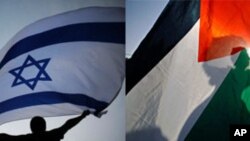
(Left): An Israeli youth waves a national flag during a rally in the coastal city of Ashkelon showing solidarity with the country's armed forces
(Right): Israeli Arabs carry a Palestinian flag during a rally to commemorate the October 2000 riots which le
(Left): An Israeli youth waves a national flag during a rally in the coastal city of Ashkelon showing solidarity with the country's armed forces (Right): Israeli Arabs carry a Palestinian flag during a rally to commemorate the October 2000 riots which le
TEXT SIZE - +

A spokesman for Palestinian President Mahmoud Abbas has criticized Israeli Prime Minister Benjamin Netanyahu's parameters for a new round of negotiations, saying they create more obstacles to peace.

Nabil Abu Rudeineh said there was "nothing new" in the Israeli peace guidelines that Mr. Netanyahu presented Tuesday in a speech to a joint meeting of the U.S. Congress.

Rudeineh said the Israeli leader has created "more obstacles" to peace by saying Jerusalem must remain what Mr. Netanyahu called Israel's "united capital" and that final Israeli borders should include major Jewish settlements in the occupied West Bank.

The Israeli prime minister said Israel also seeks to retain a "long-term military presence" in the West Bank's Jordan Valley to prevent weapons smuggling into a future Palestine.

Mr. Abbas's government has said it wants to establish a future state in all of the West Bank and the Gaza Strip, with East Jerusalem as its capital. Aides to Mr. Abbas said Tuesday his government will continue to seek international recognition of a Palestinian state at the United Nations in September.

The Hamas militant group that rules Gaza said Mr. Netanyahu's speech denies the Palestinians their rights. Hamas spokesman Sami Abu-Zuhri said the Palestinians must pursue "resistance" rather than peace talks with Israel. Mr. Netanyahu has said that Israel will not negotiate with a Palestinian government backed by Hamas.  

Israel and the United States both say Palestinian statehood must be a result of negotiations. U.S. President Barack Obama warned the Palestinians last week that "symbolic" actions to isolate Israel at the United Nations "will not create an independent state."

The head of the West Bank Jewish settlers' council, Danny Dayan, criticized Mr. Netanyahu for saying that some settlements will be located outside of Israel's final borders. Mr. Netanyahu also drew criticism from lawmakers of Israel's main opposition Kadima party who accused him of not being sincere in trying to negotiate peace with the Palestinians.


Some information for this report was provided by AP, AFP and Reuters.

Follow our Middle East reports on Twitter
and discuss them on our Facebook page.

You May Like

India, China Pledge to Overcome Border Tensions

Indian prime minister and Chinese premier attempt to move past tense standoff in the Himalayas during Delhi talks More

Burmese President Opens US Visit with VOA Town Hall Meeting

Ahead of his meeting with President Obama Monday, Thein Sein answered questions on human rights and economic development in his country More

Video Washington Week: Focus on Burma, US Government Scandals

President Thein Sein visits the White House on Monday, Congressional probes of multiple scandals are continuing More

This forum has been closed.
Comments
     
There are no comments in this forum. Be first and add one

Featured Videos

Your JavaScript is turned off or you have an old version of Adobe's Flash Player. Get the latest Flash player.
Video

Video Boston Bomber Spent 6 Months in Russia’s Most Violent Republic

The news of the Boston Marathon bombings circled the globe, and resonated here in Dagestan, a majority Muslim republic in Russia, on the shores of the Caspian Sea. Last year, Tamerlan Tsarnaev, the older of two brothers suspected of the bombings and a long-time Boston resident, returned to Dagestan, where he had lived for a year during his youth. Dagestan was the land of his maternal ancestors. But in the last two years, this republic of 3 million people has gained notoriety as the region with the highest level of political and religious violence in all of Russia. VOA's James Brooke reports from Makhachkala, Russia.