Online petitioners are calling for China to investigate what they call the "suspicious death" of a prominent dissident jailed for his involvement in the 1989 Tiananmen Square pro-democracy protests.
Li Wangyang' s family found him dead on Wednesday in his hospital room in Hunan province, apparently hanged by a bandage around his neck.
Police said Li committed suicide. But his family disputes that claim, saying Li was optimistic and had never expressed suicidal tendencies during the more than two decades he was in prison.
Human rights groups say the frail 62-year-old labor activist may not have been physically able to hang himself, as the result of health problems caused by beatings and mistreatment during his years in confinement.
A group of activists and journalists has so far collected nearly 3,000 signatures in an online petition calling for an independent autopsy and investigation into his death.
Pictures taken by the family appear to show Li's body standing at his hospital room window, with a narrow strip of cloth wrapped around his neck and his feet planted on the ground.
Li's family members say police removed the body without their permission from the hospital room, where Li was reported to have been under heavy surveillance by security guards.
The Hong Kong-based Information Center for Human Rights and Democracy in China says it is possible that the security guards who were monitoring him -- quote --"tortured him to death and faked a suicide."
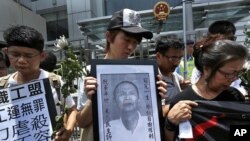
A small group of protesters gathered outside Chinese government headquarters in Hong Kong on Thursday to demand an investigation into Li's death. Politician Alan Leong believes Li was killed in retaliation for challenging the government in a Hong Kong television interview given last week.
"Every circumstance suggested to us that this was not a suicide," Leong said. "It was really the price paid by this dissident hero after he had given a short interview on Hong Kong television to say how firm he had been in calling for the vindication of the June 4 [1989] massacre."
In the interview, Li told how he had been beaten and tortured while in prison, but said he did not regret his efforts to push for democracy in China.
"Every individual is responsible for his country's well-being. In order to speed up my country's steps in becoming a democratic society, in order to realize a multi-party system earlier in China, even if you chop my head off, I will never look back," he said.
Li was sentenced to 13 years in prison after being arrested for his labor activism and "counter-revolutionary" crimes related to the 1989 pro-democracy protests. After being released in 2001, Li was re-arrested and sentenced to another 10 years in jail on charges of "inciting subversion."
He was freed last year and had been receiving treatment for various health problems suffered during his time in prison, including debilitating eye and ear conditions that reportedly left him without the ability to see or hear.
His death came just days after the 23rd anniversary of the violent government crackdown on the Beijing pro-democracy protesters, which left hundreds, if not thousands, dead.
Li Wangyang' s family found him dead on Wednesday in his hospital room in Hunan province, apparently hanged by a bandage around his neck.
Police said Li committed suicide. But his family disputes that claim, saying Li was optimistic and had never expressed suicidal tendencies during the more than two decades he was in prison.
Human rights groups say the frail 62-year-old labor activist may not have been physically able to hang himself, as the result of health problems caused by beatings and mistreatment during his years in confinement.
A group of activists and journalists has so far collected nearly 3,000 signatures in an online petition calling for an independent autopsy and investigation into his death.
Pictures taken by the family appear to show Li's body standing at his hospital room window, with a narrow strip of cloth wrapped around his neck and his feet planted on the ground.
Li's family members say police removed the body without their permission from the hospital room, where Li was reported to have been under heavy surveillance by security guards.
The Hong Kong-based Information Center for Human Rights and Democracy in China says it is possible that the security guards who were monitoring him -- quote --"tortured him to death and faked a suicide."
A small group of protesters gathered outside Chinese government headquarters in Hong Kong on Thursday to demand an investigation into Li's death. Politician Alan Leong believes Li was killed in retaliation for challenging the government in a Hong Kong television interview given last week.
"Every circumstance suggested to us that this was not a suicide," Leong said. "It was really the price paid by this dissident hero after he had given a short interview on Hong Kong television to say how firm he had been in calling for the vindication of the June 4 [1989] massacre."
In the interview, Li told how he had been beaten and tortured while in prison, but said he did not regret his efforts to push for democracy in China.
"Every individual is responsible for his country's well-being. In order to speed up my country's steps in becoming a democratic society, in order to realize a multi-party system earlier in China, even if you chop my head off, I will never look back," he said.
Li was sentenced to 13 years in prison after being arrested for his labor activism and "counter-revolutionary" crimes related to the 1989 pro-democracy protests. After being released in 2001, Li was re-arrested and sentenced to another 10 years in jail on charges of "inciting subversion."
He was freed last year and had been receiving treatment for various health problems suffered during his time in prison, including debilitating eye and ear conditions that reportedly left him without the ability to see or hear.
His death came just days after the 23rd anniversary of the violent government crackdown on the Beijing pro-democracy protesters, which left hundreds, if not thousands, dead.