


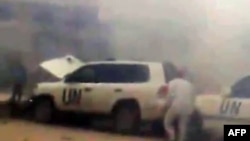
UNITED NATIONS - The United Nations says a roadside blast hit a convoy carrying a group of its unarmed observers near the Syrian city of Hama on Tuesday, damaging their vehicles but not injuring the monitors. Meanwhile, Syrian activists have accused the government of killing at least 20 mourners at a funeral in the same area.
The U.N. mission in Syria says a convoy of four of its vehicles was struck by a blast from an improvised explosive device as it drove through the town of Khan Sheikhoun, near the flashpoint city of Hama on Tuesday afternoon. U.N. spokesman Martin Nesirky said, “Three U.N. vehicles were damaged, but no U.N. personnel were hurt in this explosion. The mission has sent a patrol team to the area to help to extract those U.N. military observers.”
Upwards of 200 U.N. monitors are on the ground in Syria, mandated with monitoring the cessation of hostilities that went into effect on April 12, but which has all but collapsed with continued violence in a number of cities across the country.
Unverified video posted on You Tube allegedly showing the U.N. convoy that was damaged in an explosion Tuesday.
Among that violence, Syrian activists say that while the U.N. observers were in Khan Sheikhoun, Syrian army forces shot and killed at least 20 people during a funeral procession. There was no independent confirmation of the casualties.
Meanwhile, U.N. humanitarian chief Valerie Amos says negotiations are moving very slowly with the Syrian authorities on how aid will be distributed to the more than one million people inside the country who need it.
Amos said the government wants all aid distributed through the Syrian Arab Red Crescent. “From the U.N. perspective, of course, it is important that any aid is delivered impartially; so it needs to go to people in opposition-held areas as well as people who are in government-held areas, and monitoring is very important for us too, so we know that the aid is going to the people who most need it," she said.
Amos said some 56,000 Syrians have registered as refugees in neighboring countries, but that the actual number is likely to be much higher as many have gone unregistered.
The United Nations says more than 9,000 people have been killed since the anti-government uprising began 14 months ago. The Syrian government blames armed gangs and terrorist groups for much of the violence.
The U.N. mission in Syria says a convoy of four of its vehicles was struck by a blast from an improvised explosive device as it drove through the town of Khan Sheikhoun, near the flashpoint city of Hama on Tuesday afternoon. U.N. spokesman Martin Nesirky said, “Three U.N. vehicles were damaged, but no U.N. personnel were hurt in this explosion. The mission has sent a patrol team to the area to help to extract those U.N. military observers.”
Upwards of 200 U.N. monitors are on the ground in Syria, mandated with monitoring the cessation of hostilities that went into effect on April 12, but which has all but collapsed with continued violence in a number of cities across the country.
Unverified video posted on You Tube allegedly showing the U.N. convoy that was damaged in an explosion Tuesday.
Among that violence, Syrian activists say that while the U.N. observers were in Khan Sheikhoun, Syrian army forces shot and killed at least 20 people during a funeral procession. There was no independent confirmation of the casualties.
Meanwhile, U.N. humanitarian chief Valerie Amos says negotiations are moving very slowly with the Syrian authorities on how aid will be distributed to the more than one million people inside the country who need it.
Amos said the government wants all aid distributed through the Syrian Arab Red Crescent. “From the U.N. perspective, of course, it is important that any aid is delivered impartially; so it needs to go to people in opposition-held areas as well as people who are in government-held areas, and monitoring is very important for us too, so we know that the aid is going to the people who most need it," she said.
Amos said some 56,000 Syrians have registered as refugees in neighboring countries, but that the actual number is likely to be much higher as many have gone unregistered.
The United Nations says more than 9,000 people have been killed since the anti-government uprising began 14 months ago. The Syrian government blames armed gangs and terrorist groups for much of the violence.