


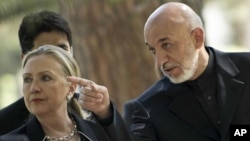
KABUL -- U.S. Secretary of State Hillary Clinton visited Kabul Saturday on a previously unannounced drop-in on her way to Tokyo for an international donor conference for Afghanistan. The Obama administration has made Afghanistan a preferred military partner eligible for quicker financing for U.S. weapons.
Clinton's stop in Kabul follows Wednesday's formal start of the long-negotiated Strategic Partnership Agreement between the two countries.
With that agreement, the Obama administration Saturday named Afghanistan a Major Non-NATO Ally -- a designation that makes it easier for countries to join in military training and acquire and finance U.S. weapons systems.
While much of that is already expedited through the international security force here, Secretary Clinton says the designation is a "powerful symbol" of the U.S. commitment to Afghanistan's future following the scheduled departure of foreign troops in 2014.
"This is the kind of relationship that we think will be especially beneficial as we do the transition and as we plan for the post-2014 presence because it will open the door to Afghanistan's military to have a greater capacity and a broader kind of relationship with the United States," Clinton said.
Afghanistan is the first nation to receive Major Non-NATO Ally status since Pakistan in 2004 and joins other U.S. allies such as Israel, Egypt, Jordan, and Japan.
Secretary Clinton met with President Hamid Karzai at the presidential palace for talks that included expectations for Sunday's Afghan donor conference in Japan.
U.S. officials say Washington intends to maintain civilian economic assistance at current levels of between $1-billion and $2-billion a year beyond 2014 with the expectation that Afghans follow through on improvements in accountability and good governance. Secretary Clinton told President Karzai that his efforts will always have U.S. support.
"We know Afghanistan has an agenda ahead of itself to make key economic reforms, to fight corruption, to strengthen the rule of law, to attract more trade and investment," Clinton said. "And I want to commend President Karzai for his strong public pledges to stamp out corruption and build institutions that will be critical for Afghanistan's future."
Secretary Clinton says the Obama administration was encouraged by a call from Pakistan's parliament that its territory not be used for any kinds of attacks on other countries and all foreign fighters shall be expelled from the country. Many Taliban attacks in Afghanistan are staged from Pakistan.
On the sidelines of Sunday's donor conference in Tokyo, Secretary Clinton will meet jointly with the foreign ministers of Afghanistan and Pakistan to discuss cross-border cooperation and security.
Clinton's stop in Kabul follows Wednesday's formal start of the long-negotiated Strategic Partnership Agreement between the two countries.
With that agreement, the Obama administration Saturday named Afghanistan a Major Non-NATO Ally -- a designation that makes it easier for countries to join in military training and acquire and finance U.S. weapons systems.
While much of that is already expedited through the international security force here, Secretary Clinton says the designation is a "powerful symbol" of the U.S. commitment to Afghanistan's future following the scheduled departure of foreign troops in 2014.
"This is the kind of relationship that we think will be especially beneficial as we do the transition and as we plan for the post-2014 presence because it will open the door to Afghanistan's military to have a greater capacity and a broader kind of relationship with the United States," Clinton said.
Afghanistan is the first nation to receive Major Non-NATO Ally status since Pakistan in 2004 and joins other U.S. allies such as Israel, Egypt, Jordan, and Japan.
Secretary Clinton met with President Hamid Karzai at the presidential palace for talks that included expectations for Sunday's Afghan donor conference in Japan.
U.S. officials say Washington intends to maintain civilian economic assistance at current levels of between $1-billion and $2-billion a year beyond 2014 with the expectation that Afghans follow through on improvements in accountability and good governance. Secretary Clinton told President Karzai that his efforts will always have U.S. support.
"We know Afghanistan has an agenda ahead of itself to make key economic reforms, to fight corruption, to strengthen the rule of law, to attract more trade and investment," Clinton said. "And I want to commend President Karzai for his strong public pledges to stamp out corruption and build institutions that will be critical for Afghanistan's future."
Secretary Clinton says the Obama administration was encouraged by a call from Pakistan's parliament that its territory not be used for any kinds of attacks on other countries and all foreign fighters shall be expelled from the country. Many Taliban attacks in Afghanistan are staged from Pakistan.
On the sidelines of Sunday's donor conference in Tokyo, Secretary Clinton will meet jointly with the foreign ministers of Afghanistan and Pakistan to discuss cross-border cooperation and security.