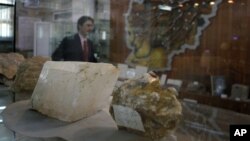
Afghanistan has become the first country to map its natural mineral resources using an advanced remote sensing technique known as hyperspectral imaging.
The mapping, a collaborative effort between the U.S. Geological Survey and the Afghan Geological Survey, generated more than 800 million pixels of data from Afghanistan's rugged and mountainous terrain.
Afghanistan's ambassador to the United States, Ekil Hakimi, says the "transparent and credible information" about its minerals has already helped to attract foreign investors.
"Countries like India, China, Canada, Turkey, and companies like Exxon, Mobil, and Chevron have all either secured contracts or expressed serious interest in resource extraction," said Hakimi.
About 70 percent of Afghanistan has been mapped with the hyperspectral imaging, giving the government a clear picture of the country's abundant natural resources, an essential tool for the development of an economically viable minerals market. Hakimi says this information is the beginning of a new vision for Afghanistan.
"This will once again establish Afghanistan as a strategic land bridge that connects the Asian and middle Eastern markets, stimulating broad-based development and economic diversification," Hakimi added.
The director of the U.S. Geological Survey, Dr. Marcia McNutt, says going to Afghanistan to map its resources with the new technology was a dream come true.
"Suddenly someone comes to you and says 'I'm going to give you more money than your agency has ever seen and you get to go - we've going to give you the key to unlock this country that for 75 years has been undiscovered from a natural resources standpoint and by the way there's a new tool that has never been used on this planet before to map natural resources,'" McNutt recalled.
McNutt says with the success Afghanistan has had with mapping its mineral assets, she is sure other countries will want to use the hyperspectral imaging technique.
The mapping, a collaborative effort between the U.S. Geological Survey and the Afghan Geological Survey, generated more than 800 million pixels of data from Afghanistan's rugged and mountainous terrain.
Afghanistan's ambassador to the United States, Ekil Hakimi, says the "transparent and credible information" about its minerals has already helped to attract foreign investors.
"Countries like India, China, Canada, Turkey, and companies like Exxon, Mobil, and Chevron have all either secured contracts or expressed serious interest in resource extraction," said Hakimi.
About 70 percent of Afghanistan has been mapped with the hyperspectral imaging, giving the government a clear picture of the country's abundant natural resources, an essential tool for the development of an economically viable minerals market. Hakimi says this information is the beginning of a new vision for Afghanistan.
"This will once again establish Afghanistan as a strategic land bridge that connects the Asian and middle Eastern markets, stimulating broad-based development and economic diversification," Hakimi added.
The director of the U.S. Geological Survey, Dr. Marcia McNutt, says going to Afghanistan to map its resources with the new technology was a dream come true.
"Suddenly someone comes to you and says 'I'm going to give you more money than your agency has ever seen and you get to go - we've going to give you the key to unlock this country that for 75 years has been undiscovered from a natural resources standpoint and by the way there's a new tool that has never been used on this planet before to map natural resources,'" McNutt recalled.
McNutt says with the success Afghanistan has had with mapping its mineral assets, she is sure other countries will want to use the hyperspectral imaging technique.