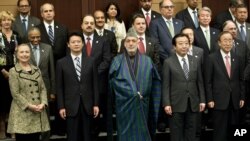
TOKYO — Senior officials from the international community are pledging billions of dollars more in civil aid for Afghanistan amid concerns terrorism and corruption still threaten progress made in the country during the past decade.
Afghanistan is receiving $16 billion in additional pledges of development aid for the next four years. But there will be more strings attached to the new assistance.
At a conference in Tokyo Sunday, donor nations and organizations reached agreement with Afghanistan on a framework for accountability. Some money will be withheld if the country cannot meet benchmarks for improving governance and finance management, as well as safeguarding the democratic process, the rule of law, and human rights, including those of women and girls.
Afghan President Hamid Karzai is promising donors a vigorous fight against corruption.
Some critics contend much of the $60 billion of aid from the international community since the Taliban was ousted by the U.S.
military more than a decade ago, has been squandered.
There has been notable progress, Afghanistan's per-capita gross domestic product of nearly $600 is five times higher than it was a decade ago.
Karzai, noting the successes, also acknowledges his country remains a dangerous place.
"Afghanistan continues to face grave risks from common threats, notably terrorism and extremism," he said. "These threats do not affect Afghanistan's security alone. Indeed the region as a whole and the world beyond will not be secure for as long as the menaces of terrorism and extremism persist, enjoying sanctuaries and support in some corners in the region beyond Afghanistan's borders.”
Officials from nearly 60 countries, including U.S. Secretary of State Hillary Clinton, converged in Tokyo for the conference.
The United Nations sent representatives from a dozen of its agencies. U.N. Secretary-General, Ban Ki-moon, used the opportunity to make a plea to help ease Afghans' “worries that they may be abandoned” after foreign military forces draw down.
“I have been urging member states that their support for Afghanistan should not be on temporary or short-term measures," he said. "They should be based on medium or longer term."
NATO ends its combat mission in Afghanistan in 2014 and the United States will also significantly reduce the number of its military forces in the country.
Japan Foreign Minister Koichiro Gemba acknowledges the new financial commitments come amid tough economic times globally.
Gemba says even though Japan and other nations face severe fiscal restraints they agree that such help to Afghanistan remains critical for that country's peace and prosperity.
Japan is the second-largest donor, after the United States, of civil aid to Afghanistan.
Afghanistan is receiving $16 billion in additional pledges of development aid for the next four years. But there will be more strings attached to the new assistance.
At a conference in Tokyo Sunday, donor nations and organizations reached agreement with Afghanistan on a framework for accountability. Some money will be withheld if the country cannot meet benchmarks for improving governance and finance management, as well as safeguarding the democratic process, the rule of law, and human rights, including those of women and girls.
Afghan President Hamid Karzai is promising donors a vigorous fight against corruption.
Some critics contend much of the $60 billion of aid from the international community since the Taliban was ousted by the U.S.
military more than a decade ago, has been squandered.
There has been notable progress, Afghanistan's per-capita gross domestic product of nearly $600 is five times higher than it was a decade ago.
Karzai, noting the successes, also acknowledges his country remains a dangerous place.
"Afghanistan continues to face grave risks from common threats, notably terrorism and extremism," he said. "These threats do not affect Afghanistan's security alone. Indeed the region as a whole and the world beyond will not be secure for as long as the menaces of terrorism and extremism persist, enjoying sanctuaries and support in some corners in the region beyond Afghanistan's borders.”
Officials from nearly 60 countries, including U.S. Secretary of State Hillary Clinton, converged in Tokyo for the conference.
The United Nations sent representatives from a dozen of its agencies. U.N. Secretary-General, Ban Ki-moon, used the opportunity to make a plea to help ease Afghans' “worries that they may be abandoned” after foreign military forces draw down.
“I have been urging member states that their support for Afghanistan should not be on temporary or short-term measures," he said. "They should be based on medium or longer term."
NATO ends its combat mission in Afghanistan in 2014 and the United States will also significantly reduce the number of its military forces in the country.
Japan Foreign Minister Koichiro Gemba acknowledges the new financial commitments come amid tough economic times globally.
Gemba says even though Japan and other nations face severe fiscal restraints they agree that such help to Afghanistan remains critical for that country's peace and prosperity.
Japan is the second-largest donor, after the United States, of civil aid to Afghanistan.