


While the tsunami-caused nuclear plant emergency in Japan is leading to reassessments of nuclear energy policy around the world, in Africa, experts say challenges remain the same as before. They say limits to expanding nuclear power on the continent are of a financial nature, as well as related to fears of political instability.
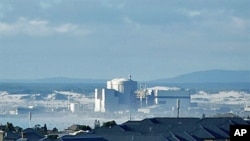
Africa has just two working nuclear reactors, both of them in South Africa, from that country's Koeberg power station.
A week after the earthquake and tsunami in Japan, South Africa's Cabinet ratified a new plan calling for nuclear power to fuel nearly a quarter of the country's future electricity production.
Pebble bed reactors
But last year a so-called pebble bed reactor project by the government's utility company Eskom was abandoned because of a lack of funds and also concerns over its potential performance.
Arizona State University professor G. Pascal Zachary is closely tracking Africa's energy sector, including South Africa's ambitions.
"The idea of investing heavily in a still experimental nuclear energy technology called the pebble bed, that seems like a poor bet," said Zachary. "So Eskom is actually cutting back on the pebble bed because they just do not have the resources to make the investments in it that are required."
New nuclear plants with older technology usually also cost in the tens of billions of dollars, with most of the money needed upfront.
Costly energy
Dan Yurman, who writes a widely read blog on nuclear energy called Idaho Samizdat, said cost is a main reason African countries are not building more nuclear plants.
Even though the continent's nuclear exception, South Africa, wants to move away from coal into more nuclear, Yurman predicts an opposite trend.
"My view is they may have to go back to coal because they do have those resources and they can build those plants relatively quickly. That is not good for global warming, but it will keep the lights on," he said.
Another African country, the Democratic Republic of Congo, has had a nuclear research reactor for decades. After the nuclear leak in Japan, concerns were raised that its own reactor was sitting on sliding terrain in the capital Kinshasa.
But the commissioner of the Kinshasa Regional Center for Nuclear Studies, Vincent Lukanda Muamba, says the reactor is idle, but safe.
Muamba said the reactor is not working because of the need to change its control bay from an analog to a digital system. The new parts are estimated to cost several million dollars.
The Congo has a long nuclear history. Its uranium was used for the so-called Manhattan project to make the world's first nuclear bomb, which the U.S. military dropped on Hiroshima, Japan, in 1945.
Igor Khripunov, from the Center for International Trade and Security at the University of Georgia, said that for one of the few sub-Saharan countries that could maybe afford a new nuclear plant, Nigeria, the main concern is political instability.
Political instability concerns
"Unfortunately, Nigeria is not the best candidate, given violence and lack of government ability to control the situation inside the country," said Khripunov. "It has resources. It has money, but most countries are very reluctant to see a nuclear power infrastructure emerging in Nigeria given the very unstable situation inside the country. There was even a statement by the European Union expressing concern about it."
In the short term, energy experts say Nigeria should focus more on developing its natural gas potential, while other African countries with access to rivers should keep on developing dam projects for distributing hydroelectric power. They say wind and solar power also should be further pursued. But they say, in the future, nuclear power could become an option.
More and more countries, including Russia, China and South Korea, are trying to develop cheaper and smaller nuclear plants, which energy experts, such as Khripunov, say could eventually become an energy solution for richer and more stable African countries.
"Instead of building huge 1,000 Megawatt nuclear power plants, as we were used to in the past, there may be a series, a cluster, of smaller reactors adjusted to grids that are now in existence in Africa," said Khripunov.
For most sub-Saharan African countries, Khripunov said, talk of developing nuclear power now is more about enhancing status and prestige than based in actual possibilities.
One example is resource-poor Senegal, which has experienced more and more blackouts in recent years. Last week, Senegal President Abdoulaye Wade said that in the wake of Japan's nuclear emergency, he was abandoning plans to build a nuclear power plant, and that he had canceled an order for nuclear equipment from a Russian company he did not identify.