



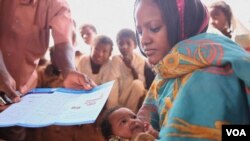
Over the next three months, about 50 million young people in seven African countries will be vaccinated against meningitis. It’s part of larger campaign to eliminate the disease in 26 at-risk countries.
Meningitis is a swelling of the protective membranes of the brain and spinal cord. It’s usually caused by a bacterial or viral infection and can kill quickly. Symptoms include a high fever, vomiting, headache, stiff neck and back, confusion and a heightened sensitivity to light. Those who survive may suffer from deafness, brain damage and learning difficulties.
“Meningitis is really devastating for these countries. It’s very unpredictable. It sweeps in unannounced every seven to fourteen years. And when it comes to a country it really causes huge problems. For a start, a lot of people fearing the disease, fearing the death and illness that it brings--they decide to stop gathering and getting together in large groups. So this means children not going to school or adults actually not going to work,” said Dan Thomas of the GAVI Alliance, a Geneva-based public-private partnership working on improving health in poor countries.
Africa has a “meningitis belt” that stretches from Senegal in the west to Ethiopia in the east. The first phase of meningitis immunizations began in Burkina Faso in 2010. About 12 million people were vaccinated. Health officials say since then no cases of the disease have been reported in the country.
The countries targeted in the current phase - between October and December - are Benin, Cameroon, Chad, Ghana, Nigeria, Senegal and Sudan.
Thomas said that the immunizations target meningitis caused by a virus and will be given to babies, children and young adults.
“This is a vaccine called MenAfriVac. It’s a vaccine against meningitis A, which sweeps through these countries at this time of year before the rainy season, and affects more than 430 million people, who are at risk from illness and death,” he said.
He added the vaccine costs only one half U.S. dollar, or 50 cents, per dose.
“One of the key ideas behind it was that it had to be a vaccine which was affordable. Affordable to GAVI so that we could roll it out for more than 400 million people, but also crucially that these countries take on the cost of the vaccines themselves.”
The immunization campaign is a partnership involving the GAVI Alliance, the World Health Organization, UNICEF, the Serum Institute of India and the Meningitis Vaccine Project.
Meningitis is a swelling of the protective membranes of the brain and spinal cord. It’s usually caused by a bacterial or viral infection and can kill quickly. Symptoms include a high fever, vomiting, headache, stiff neck and back, confusion and a heightened sensitivity to light. Those who survive may suffer from deafness, brain damage and learning difficulties.
“Meningitis is really devastating for these countries. It’s very unpredictable. It sweeps in unannounced every seven to fourteen years. And when it comes to a country it really causes huge problems. For a start, a lot of people fearing the disease, fearing the death and illness that it brings--they decide to stop gathering and getting together in large groups. So this means children not going to school or adults actually not going to work,” said Dan Thomas of the GAVI Alliance, a Geneva-based public-private partnership working on improving health in poor countries.
Africa has a “meningitis belt” that stretches from Senegal in the west to Ethiopia in the east. The first phase of meningitis immunizations began in Burkina Faso in 2010. About 12 million people were vaccinated. Health officials say since then no cases of the disease have been reported in the country.
The countries targeted in the current phase - between October and December - are Benin, Cameroon, Chad, Ghana, Nigeria, Senegal and Sudan.
Thomas said that the immunizations target meningitis caused by a virus and will be given to babies, children and young adults.
“This is a vaccine called MenAfriVac. It’s a vaccine against meningitis A, which sweeps through these countries at this time of year before the rainy season, and affects more than 430 million people, who are at risk from illness and death,” he said.
He added the vaccine costs only one half U.S. dollar, or 50 cents, per dose.
“One of the key ideas behind it was that it had to be a vaccine which was affordable. Affordable to GAVI so that we could roll it out for more than 400 million people, but also crucially that these countries take on the cost of the vaccines themselves.”
The immunization campaign is a partnership involving the GAVI Alliance, the World Health Organization, UNICEF, the Serum Institute of India and the Meningitis Vaccine Project.