Africa Security Challenges Demand Obama's Attention
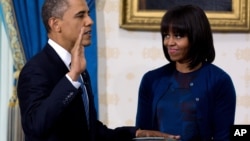
President Obama takes the oath of office at the official swearing-in ceremony in the Blue Room of the White House, January 20, 2013.
NAIROBI —
As U.S. President Barack Obama begins his second term in office, his administration faces urgent security challenges in Africa. Top on the list is the conflict in Mali, which analysts say may cause the United States to rethink its counterterrorism strategy in Africa.
While U.S. drones and surveillance planes buzz the skies above conflict zones across Africa, the U.S. president has engaged little in African affairs.
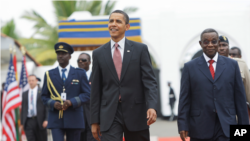
President Barack Obama walks with Ghana President John Atta Mills, right, at the Presidential Palace in Accra, Ghana, Saturday, July 11, 2009.
During his first term in office, Obama made only one trip to Africa - a stop in Ghana that lasted less than 24 hours.
But an Islamist militant insurgency in Mali, fueled by the North African branch of al-Qaida, could raise Africa's security challenges to a more prominent place on Obama's second-term agenda.
Paul-Simon Handy, the head of the conflict prevention and risk analysis division at the Institute for Security Studies in South Africa, said, "I think the Obama administration will focus a bit on that part of the continent as a global challenge, not only to state-building, but as a global terrorist challenge.”
To address the crisis in Mali, the U.S. is sending about 100 military trainers to countries in West Africa, contributing troops to a regional military force being deployed to support Mali's national army.
While this strategy of building the capacity of African militaries rather than deploying U.S. troops has been typical of the Obama administration's response to conflict in Africa, it does not always work.
In Mali, the United States has spent millions of dollars during the past decade training counter-terrorism forces, but still could not prevent the takeover of the country's north by Islamist militants.
Handy says to avoid past mistakes, the United States should put more effort into diplomatic engagement and working with African states to build solid government institutions.
"Focusing too much on the military has in a sense led to a setback in the democratic gains in certain regions like West Africa. What the U.S. will have to change is to look at the fight against terrorism in a holistic way," he said.
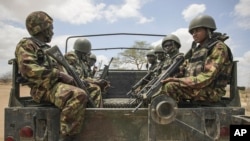
In this photo released by the African Union-UN Information Support Team, Kenyan soldiers serving with the African Union Mission in Somalia at their sector headquarters in Dhobley, September 30, 2012.
Meantime, U.S. officials have been encouraged by the political and security progress made in Somalia during the past four years, which could be a clue as to how the country will engage Africa in the years ahead.
The United States been one of the biggest financial supporters of the African Union peacekeeping mission in Somalia, while Washington has also engaged Somali politicians throughout a long political transition.
In a speech last week, Assistant Secretary of State Johnnie Carson said the Obama administration's strategy in the country could serve as a “potential model for the resolution of other conflicts on the continent.”