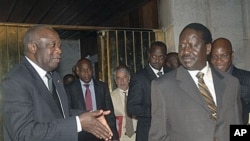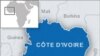



The leaders of Burkina Faso, Chad, Mauritania, South Africa, and Tanzania meet in Nouakchott, Mauritania to hear from African Union officials about the stalemate between Ivory Coast's incumbent president Laurent Gbagbo and the United-Nations-certified winner of November's vote, former prime minister Alassane Ouattara.
The five heads of state are due to travel to Ivory Coast Monday to meet with the rivals. Mr. Gbagbo's claim to re-election is based on the constitutional council annulling as fraudulent, nearly 10 percent of all ballots cast. Mr. Ouattara's claim to the presidency is based on results released by the electoral commission and certified by the United Nations.
Mr. Gbagbo's government says it will accept the African Union mediation so long as it does not challenge the constitutional council declaration that Mr. Gbagbo won. Mr. Ouattara's prime minister says Ivorians should not expect anything from the African Union and should instead rise up in an Egyptian-style revolt.
Cooperation encouraged
U.N. Secretary General Ban Ki-moon says all Ivorians should fully cooperate with an African Union panel that he says is of great importance. Martin Nesirky is his spokesman.
"The Secretary-General is concerned about the continuing violence and the planned demonstrations which could increase tensions and undermine the prospects for an early and peaceful end to the crisis," Nesirky said. "He calls for an immediate end to the acts of violence against the civilian population and for restraint in the planned demonstrations. He also calls for an end to the obstruction of the operations of the United Nations Operation in Côte d'Ivoire [UNOCI], and the removal of the siege on the Golf Hotel."
Mr. Gbagbo's government has previously said it will not lift its siege of Mr. Ouattara's hotel because there are several hundred former rebels there who cannot be allowed to move freely.
Money & politics
International and regional sanctions against the Gbagbo government have led to the near-collapse of Ivory Coast's financial system with five international banks closing this week.
Jules Camara stood outside a bank hoping to withdraw as much money as he could.
Camara says the situation is making everyone nervous because banks closed with all the money everyone had in the banks. When you look at the line of people, he says, you do not know who is from the Ouattara party or the Gbagbo party. Camara says the best solution is not to involve the banking sector with politics.
Politics is what drove those banks to close after the West African central bank threatened to penalize commercial banks that continued to do business in Ivory Coast after the central bank severed Mr. Gbagbo's access to state funds.
Mr. Gbagbo's government says it will now take complete control of the capital of closed branches of Citibank, Societe Generale, and BNP Paribas. Standard Chartered bank and the Nigerian Access Bank have also closed along with the Ivorian-owned International Bank for West Africa and Banque Atlantique.
Nationalizing banks is the latest sign of Ivory Coast's deteriorating economy with a shortage of cooking gas, cocoa exports blocked and the Abidjan-based regional stock exchange suspended. Because of the breakdown in the banking system, Ivory Coast's national airline has suspended all flights until the middle of next week.
African Union Panel Prepares for Ivory Coast Mediation