


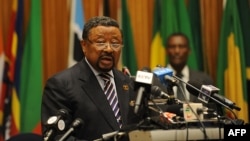
African Union Commission Chairman Jean Ping says the crisis in Mali is one of the biggest threats to regional stability. A.U. heads of state met in Addis Ababa Saturday to consider efforts to resolve the situation in Mali and other regional conflicts.
Mali topped the agenda at an A.U. Peace and Security Council meeting in the Ethiopian capital, ahead of an A.U. summit.
At the start of the closed-door meeting, A.U. Commission Chairman Ping stressed the urgency of stabilizing the country.
“The situation in Mali is one of the most serious we are confronting on the continent,” he said. “It's persistence is posing a threat to the viability of the state of Mali and the stability and security of the region,” said Ping.
Islamist militants have seized control of towns in northern Mali, in the wake of a political rebellion launched by Tuareg separatists.
The militant groups have carried out severe beatings in towns under their control, and have destroyed ancient Muslim shrines they claim are sacrilegious.
The African Union is working with the western regional bloc ECOWAS to support Mali's interim government, installed after a March 22 coup, and to discuss options for confronting the Islamist insurgency.
ECOWAS is considering a military intervention by African forces, and is awaiting a formal request by the Malian government and official backing from the United Nations Security Council.
In prepared remarks for the A.U. Peace and Security Council meeting, U.N. Deputy Secretary-General Jan Eliasson said military action “should only be considered if all avenues for dialogue have been exhausted.”
Chairman Ping said the council is also reviewing progress in negotiations between Sudan and South Sudan on disputes left unresolved following their separation last year.
He said progress in talks has been “slow and uneven” but added he was pleased by the willingness of both sides to return to dialogue in a “spirit of partnership.”
Negotiators from the two countries resumed talks Thursday on security and border issues, but have so far failed to reach agreement.
Sudanese President Omar al-Bashir and South Sudanese President Salva Kiir both attended Saturday's meeting.
Mali topped the agenda at an A.U. Peace and Security Council meeting in the Ethiopian capital, ahead of an A.U. summit.
At the start of the closed-door meeting, A.U. Commission Chairman Ping stressed the urgency of stabilizing the country.
“The situation in Mali is one of the most serious we are confronting on the continent,” he said. “It's persistence is posing a threat to the viability of the state of Mali and the stability and security of the region,” said Ping.
Islamist militants have seized control of towns in northern Mali, in the wake of a political rebellion launched by Tuareg separatists.
The militant groups have carried out severe beatings in towns under their control, and have destroyed ancient Muslim shrines they claim are sacrilegious.
The African Union is working with the western regional bloc ECOWAS to support Mali's interim government, installed after a March 22 coup, and to discuss options for confronting the Islamist insurgency.
ECOWAS is considering a military intervention by African forces, and is awaiting a formal request by the Malian government and official backing from the United Nations Security Council.
In prepared remarks for the A.U. Peace and Security Council meeting, U.N. Deputy Secretary-General Jan Eliasson said military action “should only be considered if all avenues for dialogue have been exhausted.”
Chairman Ping said the council is also reviewing progress in negotiations between Sudan and South Sudan on disputes left unresolved following their separation last year.
He said progress in talks has been “slow and uneven” but added he was pleased by the willingness of both sides to return to dialogue in a “spirit of partnership.”
Negotiators from the two countries resumed talks Thursday on security and border issues, but have so far failed to reach agreement.
Sudanese President Omar al-Bashir and South Sudanese President Salva Kiir both attended Saturday's meeting.