



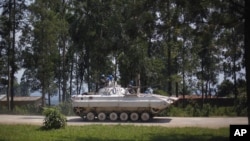
KAMPALA — Leaders of Africa's Great Lakes region are meeting in the Ugandan capital to discuss sending an international force into the eastern Democratic Republic of Congo.
The leaders of the eleven countries that make up the African Great Lakes region gathered in Kampala, Uganda today to address the latest crisis in eastern Congo, where the government has been battling rebel groups for years.
During the meeting, the leaders discussed sending a neutral, international force into eastern Congo to fight a rebel group known as M23. An ethnically Tutsi group of mutineers, M23 has been seizing swaths of territory since April.
The United Nations claims that the rebels are being supported by neighboring Rwanda. Rwanda denies the charges. But if true, this would not be the first time the country had become involved in a Congolese rebellion. In the 1990s, both Rwanda and Uganda both sent troops into eastern Congo to support rival factions.
Some have accused Uganda of backing the M23 rebels as well, which the Ugandan government vehemently denies. According to Thierry Vircoulon, the Central Africa project director for the International Crisis Group, there is little evidence to support such an accusation. But, he says, there could be indirect support coming from Uganda, even if it is not from the government itself.
“There's a lot of allegations circulating around and of course a lot of Congolese think that what's happening now is a repetition of what happened in the '90s when Uganda and Rwanda backed proxies in eastern Congo," says Vircoulon. "However it also very possible that some warlords in eastern Congo still have connections in Uganda and are still using them.”
Congo’s Information Minister Lambert Mende insists that the messy history of the Great Lakes region makes it impossible for certain countries, such as Uganda and Rwanda, to be part of any neutral force deployed in eastern Congo.+
“It must go beyond the region,"says Mende. "It is a neutral force, that is to say that neither Congo nor Rwanda can be part of this force, or any other country that can be suspected of not being neutral in this very, very long conflict.”
But Vircoulon calls the proposal for a neutral force a “diplomatic distraction," adding that the U.N. and African Union are too busy to actually deploy troops to the DRC. Nor are the Great Lakes countries willing to finance such a force themselves, Vircoulon says.
“When it comes to the African force that should be deployed they, as usual, turn to the African Union and the U.N. to support it, which basically means that ‘we agree to send such a force, but we need your support financially and logistically’, which is, of course, raising a lot of skepticism,” he says.
The summit in Kampala follows on the heels of a meeting last week in Khartoum, in which the Great Lakes defense ministers gathered to discuss the proliferation of rebel groups in eastern Congo.
The leaders of the eleven countries that make up the African Great Lakes region gathered in Kampala, Uganda today to address the latest crisis in eastern Congo, where the government has been battling rebel groups for years.
During the meeting, the leaders discussed sending a neutral, international force into eastern Congo to fight a rebel group known as M23. An ethnically Tutsi group of mutineers, M23 has been seizing swaths of territory since April.
The United Nations claims that the rebels are being supported by neighboring Rwanda. Rwanda denies the charges. But if true, this would not be the first time the country had become involved in a Congolese rebellion. In the 1990s, both Rwanda and Uganda both sent troops into eastern Congo to support rival factions.
Some have accused Uganda of backing the M23 rebels as well, which the Ugandan government vehemently denies. According to Thierry Vircoulon, the Central Africa project director for the International Crisis Group, there is little evidence to support such an accusation. But, he says, there could be indirect support coming from Uganda, even if it is not from the government itself.
“There's a lot of allegations circulating around and of course a lot of Congolese think that what's happening now is a repetition of what happened in the '90s when Uganda and Rwanda backed proxies in eastern Congo," says Vircoulon. "However it also very possible that some warlords in eastern Congo still have connections in Uganda and are still using them.”
Congo’s Information Minister Lambert Mende insists that the messy history of the Great Lakes region makes it impossible for certain countries, such as Uganda and Rwanda, to be part of any neutral force deployed in eastern Congo.+
“It must go beyond the region,"says Mende. "It is a neutral force, that is to say that neither Congo nor Rwanda can be part of this force, or any other country that can be suspected of not being neutral in this very, very long conflict.”
But Vircoulon calls the proposal for a neutral force a “diplomatic distraction," adding that the U.N. and African Union are too busy to actually deploy troops to the DRC. Nor are the Great Lakes countries willing to finance such a force themselves, Vircoulon says.
“When it comes to the African force that should be deployed they, as usual, turn to the African Union and the U.N. to support it, which basically means that ‘we agree to send such a force, but we need your support financially and logistically’, which is, of course, raising a lot of skepticism,” he says.
The summit in Kampala follows on the heels of a meeting last week in Khartoum, in which the Great Lakes defense ministers gathered to discuss the proliferation of rebel groups in eastern Congo.