



Under Russian President Dmitry Medvedev, Russia has found common ground with Washington - on shipping war supplies to Afghanistan, halting the sale of anti-aircraft missiles to Iran and joining the World Trade Organization.
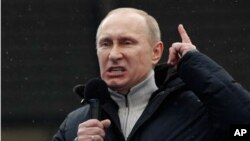
With Prime Minister Vladimir Putin leading all polls prior to Sunday’s presidential vote, though, the question of how Russia’s foreign policy would change under his return to the presidency is coming into focus.
In a 7,500-word foreign policy essay released Monday, the prime minister is promising a Russia with sharper elbows that vigorously pushes back against the West and forces it to take Moscow’s views into account.
Writing that "Russia is only treated with respect when it is strong and stands firm on its own two feet," he says "the only way to ensure global security is by doing it together with Russia, not by trying to ‘demote’ it, weaken it geopolitically, or undermine its defensive potential."
If Putin wins the presidential election on Sunday, he would rule Russia, the world’s largest country, through 2018.
Viktor Kremenyuk, a deputy director of the Institute for U.S. and Canadian Studies, predicts that Kremlin cooperation with the West would be on a case by case basis.
"If you want [the Kremlin] to cooperate, you should think about something, about carrots and sticks, you know, some system of encouragement, which so far we didn't see at all," he says, explaining that some Russian have lingering doubts about dealing with the West.
"Russians still are very suspicious," he says. "They don't believe that the West is really taking Russia seriously and is ready to cooperate with Russia on an equal basis."
On Washington and the Middle East
Talking tough to Washington in his essay, Putin complains of "regular U.S. attempts to engage in ‘political engineering,’ including in regions that are traditionally important to us and during Russian elections."
As a young KGB agent in the early 1980s, Putin’s job was to monitor foreigners and dissidents in Leningrad (now St. Petersburg). Thirty years later, he is attacking foreign funded non-governmental groups, writing that "pseudo-NGOs and other agencies that try to destabilize other countries with outside support are unacceptable."
He is also promising to fight Washington’s anti-Iranian missile defense plan, saying it would destabilize the nuclear-missile balance between Russia and the United States. He interprets the Arab Spring as a Western bid for influence and markets, while Libya, he says, is the West’s gain and Russia’s loss.
On Syria, he promises to hold the line.
Arguing against possession of nuclear weapons by two of Russia’s southern neighbors, Iran and North Korea, he simultaneously warns the West against exerting pressure on North Korea’s new leader, Kim Jong-un, and says an attack on Iran’s nuclear program would be "truly catastrophic."
Explaining that some foreign leaders seek nuclear weapons to protect themselves from Western intervention, he writes of their reasoning: "If I have an A-bomb in my pocket, nobody will touch me because it’s more trouble than it’s worth."
Strong ties with Beijing
Putin’s only warm words are for China.
Stressing the political and diplomatic cooperation between Moscow and Beijing, he seems to be reassuring voters that the nation’s eastern back is covered. He praises China’s economic expansion, saying it gives Russia "a chance to catch the Chinese wind in the sails of our economy."
According to Alexander Lukin, director of East Asian Studies at Moscow State University, Russia wants to expand trade and investment with China.
"As Mr. Putin said, we need to use Chinese prosperity and growth for our own sake, for our own purposes," he says. "Because ... that China is growing is a fact, [and] one cannot change it. So you have to take it as reality."
But from the United Nations to NATO to the Arab League, it looks as if the world can increasingly expect a Russia that pushes back.