


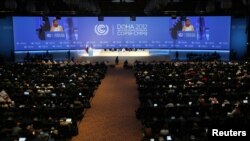
As delegates meet at the United Nations Climate Change Conference in Doha, Qatar, to craft a new international climate agreement after the 1997 Kyoto treaty expires next month, another group will be calling attention to the huge role agriculture could play in being part of the solution to climate change.
Agriculture, Landscapes, and Livelihoods Day will take place at the conference on December 3. The event hopes to put into place a dedicated work program to help farmers adapt to climate change, and to showcase solutions agriculture can provide in mitigating the effects of climate change.
Dr. Lindiwe Sibanda, is CEO of the Africa-wide Food, Agriculture and Natural Resources Policy Analysis Network, FANRPAN, and is also spokesperson for global-agriculture coalition Farming First. She said agriculture is a crucial sector for many economies, especially the developing countries. It supports the livelihoods for millions of people and also provides socio-economic empowerment, so it is vitally important that agriculture be a part of the talks in Doha.
“Well, I think the main thing to appreciate is that agriculture contributes to global emissions. But, at the same time, good agriculture is good for the environment, and it can actually reduce emissions and also counter any emissions that are already out there, explained Sibanda, who added, while improving agriculture techniques is a global issue, it is particularly important for Africa.
“I think when you look at negotiations, you are looking at Africa as a continent with close to 54 countries that are members of the U.N., out of close to 200 member countries of the U.N. We are saying, particularly for developing countries, particularly for Africa, where our heads of state have articulated that agriculture is the backbone of our economy. We are calling on all of the African negotiators to prioritize agriculture, and push for a deal that recognizes a work program for agriculture," said Sibanda.
She explained at present, African farmers are producing only about one-tenth of what they could be producing, due to difficult environmental conditions and a lack of technology.
She said now is the time to focus on improving the use of natural resources and technology, “the technologies on the shelf need to be adapted to the local environment. And that’s why local research at local levels is a critical role to play. And then finally, we know there are technologies such as conservation agriculture, which can allow us to reduce emissions and use natural resources to enhance the fertility of our soil. And other technologies that farmers are willing to adopt, so that they can adapt to climate change.”
Sibanda stressed these types of improvements require money that many developing countries do not have, and this too creates more challenges.
“The extension services need to be beefed-up so farmers can access knowledge. The research needs to downscale technology to the farmer level. So that too needs investment and finances… so farmers are willing to adapt in Africa, but they need help in accessing the technology. And the technology needs to be appropriate for their conditions,” said Sibanda.
Sibanda described the Agriculture Day conference scheduled for December 3 as having more significant meaning for this year’s climate conference, “this year we are not just calling it, Agriculture and World Development, we’re calling it Agriculture, Landscapes and Livelihoods because the people are important in this whole process. The landscapes are important, and we are hoping to showcase some of the specific solutions for mitigating and adaptation, that can benefit farmers, particularly small-holder farmers.”
Sibanda emphasized putting agriculture in the spotlight is not just for the benefit of Africa. She said food security is a global issue, and farmers worldwide are producing food under very difficult circumstances. The climate conference is a good way to showcase gaps in knowledge regarding mitigating the effects of climate change, and offers a platform for educating, and implementing solutions to the effects of climate change.
Agriculture, Landscapes, and Livelihoods Day will take place at the conference on December 3. The event hopes to put into place a dedicated work program to help farmers adapt to climate change, and to showcase solutions agriculture can provide in mitigating the effects of climate change.
Dr. Lindiwe Sibanda, is CEO of the Africa-wide Food, Agriculture and Natural Resources Policy Analysis Network, FANRPAN, and is also spokesperson for global-agriculture coalition Farming First. She said agriculture is a crucial sector for many economies, especially the developing countries. It supports the livelihoods for millions of people and also provides socio-economic empowerment, so it is vitally important that agriculture be a part of the talks in Doha.
“Well, I think the main thing to appreciate is that agriculture contributes to global emissions. But, at the same time, good agriculture is good for the environment, and it can actually reduce emissions and also counter any emissions that are already out there, explained Sibanda, who added, while improving agriculture techniques is a global issue, it is particularly important for Africa.
“I think when you look at negotiations, you are looking at Africa as a continent with close to 54 countries that are members of the U.N., out of close to 200 member countries of the U.N. We are saying, particularly for developing countries, particularly for Africa, where our heads of state have articulated that agriculture is the backbone of our economy. We are calling on all of the African negotiators to prioritize agriculture, and push for a deal that recognizes a work program for agriculture," said Sibanda.
She explained at present, African farmers are producing only about one-tenth of what they could be producing, due to difficult environmental conditions and a lack of technology.
She said now is the time to focus on improving the use of natural resources and technology, “the technologies on the shelf need to be adapted to the local environment. And that’s why local research at local levels is a critical role to play. And then finally, we know there are technologies such as conservation agriculture, which can allow us to reduce emissions and use natural resources to enhance the fertility of our soil. And other technologies that farmers are willing to adopt, so that they can adapt to climate change.”
Sibanda stressed these types of improvements require money that many developing countries do not have, and this too creates more challenges.
“The extension services need to be beefed-up so farmers can access knowledge. The research needs to downscale technology to the farmer level. So that too needs investment and finances… so farmers are willing to adapt in Africa, but they need help in accessing the technology. And the technology needs to be appropriate for their conditions,” said Sibanda.
Sibanda described the Agriculture Day conference scheduled for December 3 as having more significant meaning for this year’s climate conference, “this year we are not just calling it, Agriculture and World Development, we’re calling it Agriculture, Landscapes and Livelihoods because the people are important in this whole process. The landscapes are important, and we are hoping to showcase some of the specific solutions for mitigating and adaptation, that can benefit farmers, particularly small-holder farmers.”
Sibanda emphasized putting agriculture in the spotlight is not just for the benefit of Africa. She said food security is a global issue, and farmers worldwide are producing food under very difficult circumstances. The climate conference is a good way to showcase gaps in knowledge regarding mitigating the effects of climate change, and offers a platform for educating, and implementing solutions to the effects of climate change.