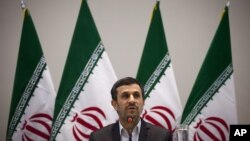
Iranian President Mahmoud Ahmadinejad (June 21, 2012 file photo)
As the Iranian rial continued to tumble to new lows on Tuesday, Iranian president Mahmoud Ahmadinejad attempted to deflect internal criticism that his policies are contributing to the decline.
During a press conference in Tehran, he blamed “psychological pressures” linked to Western sanctions and criticized other politicians who have said the collapse of the currency has been worsened by his economic policies.
Ahmadinejad directly named parliament speaker Ali Larijani who said 80 percent of Iran’s economic problems are a result of government mismanagement and only 20 percent because of sanctions. Western sanctions have severely restricted Iran’s ability to sell oil on the world market and limited its access to the international banking system.
"The speaker should help the government overcome the problem instead of accusing the administration," Ahmadinejad told reporters his first news conference since returning from the U.N. General Assembly.
Larijani is among the possible candidates for next June's presidential elections that will select Ahmadinejad's successor.
Other politicians have called for Ahmadinejad to appear before lawmakers to answer questions about the rial’s decline. According to the parliament’s website, one member, Mohammad Bayatian, claimed to have enough signatures to force Ahmadinejad to provide answers.
Bringing Ahmadinejad before the parliament would not be without precedent. Earlier this year, he was called before the 290-seat body to answer questions about his public feud with supreme leader Ayatollah Ali Khameni.
In the press conference, Ahmadinejad referred to Western sanctions, saying they are part of a "heavy battle" that has succeeded in driving down oil exports "a bit," but he provided no data.
He also claimed Iran has enough hard currency to meet the country's needs.
The falling rial appears to indicate otherwise, as it hit a low of 35,000 rials to the dollar Tuesday. On Sunday, the rial traded at 29,500 to the dollar, and two years ago, it was about 10,000 to the dollar.
Alex Vatanka, a scholar at the Middle East Institute said it was interesting that the Iranian regime seems surprised by the effect of economic sanctions.
“The Iranian public has taken the sanctions seriously,” he said. “They have taken their money out of the banks, and I can tell you a lot of people have bought property and gold.”
Iranians started to react to Ahmadinejad’s public comments on social media from the beginning of the press conference, which was being broadcast live on Iran’s state television. Many users were critical of the government’s policies and expressed concern for the future.
Fakhri Mohtashamipour, the wife of a former deputy minister who is now in prison, wrote “I feel pity for the people of Iran.”
Mana Neyestani's cartoon about the fall of the Iranian rial has been widely circulated on social media.
Some users mocked the Iranian president calling the conference “stand up comedy” while others expressed concern over the amount of finger pointing.
The currency situation has gotten so bad that one Iranian from Qom told VOA that when they were trying to buy an external hard drive, the shopkeeper insisted on payment in dollars.
Qom is home to Iran’s religious leaders and is widely viewed as a city somewhat insulated from wider economic problems.
“Clearly the dollar is in short supply,” said Vatanka. “It might start with a hard drive, but perhaps someday medicine could be sold for dollars. We’ve really walked into a whole new phase in this [nuclear] standoff.”
Some information for this report was provided by AP.