


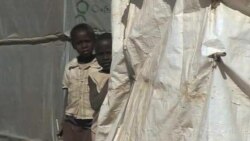

It's been 10 years since the conflict in the Darfur region of Sudan broke out. Aid agencies say the international community has forgotten about the war and the millions of refugees forced from their homes, as attention has turned to the Arab Spring.
An estimated 300,000 people have died in the decade-long conflict in Darfur, most of them civilians. Almost two million have fled their homes.
Abakar Adam has lived in a refugee camp near the town of El Fasher since the fighting began in 2003.
"If things go well and peace comes I'll return one day and will stay here no more," he said. "But the first thing we need is the disarmament of the people who carry weapons."
It's a conflict the world has largely forgotten, says Andrej Mahecic of the Office of the United Nations High Commissioner for Refugees, or UNHCR.
"Often the donors' attention, and attention of the world in general, tends to go towards the most visible and most dramatic and current crisis. But the fact of the matter is we are now dealing in Darfur with a protracted situation; it's been now 10 years, the needs are still there," he said.
The conflict began with a crackdown on rebel uprisings in Darfur by government-backed militia known as the "Janjaweed."
Sudanese President Omar al-Bashir, who is wanted by the International Criminal Court for alleged war crimes against civilians in Darfur, denies the accusations.
As the conflict enters its second decade, the United States has called for an effective and inclusive political process.
Andrej Mahecic of the UNHCR said, "Since January this year, we have seen about 100,000 people fleeing the [latest] round of violence. On the other hand, there are areas such as West Darfur which are enjoying relative peace and stability, and we have seen almost a quarter of a million people returning since the beginning of 2011. So it is a very different, a fluid situation."
The charity Kids For Kids helps families to stay in their remote villages by loaning goats and donkeys, while building basic services like water pumps.
Its founder, Patricia Parker, says just small donations make a difference, but they've fallen away in recent years.
"People think that because Darfur hasn't been in the news, that it must be all right," she said. "So they've moved on to other things. There are other disasters elsewhere in the world. What is a tragedy is that these families are beyond deprivation, beyond poverty."
Parker says rocketing inflation in Sudan has halved the income of many households, making life even tougher.
"The indirect effects of violence are actually worse - and they're out of sight - than you can possibly imagine," she said. "We had the tragic news that in a very small village of just 2,000 people, 50 children died of malnutrition alone. That didn't allow for malaria and all the other things that we know are terrible killers in places like Darfur."
On the tenth anniversary of the Darfur conflict, aid agencies say the fighting and the suffering continue - unseen and forgotten.