



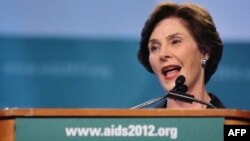
New concerns and renewed hope are taking center stage at the 2012 International AIDS Conference in Washington D.C..
Former first lady Laura Bush reminded conference attendees that despite all of the difficulties in fighting HIV and AIDS, the past decade has seen tremendous progress.
"Rather than waiting quietly for death, millions who suffer from HIV are now working and participating in their communities," Bush said.
Bush and her husband, former president George W. Bush, traveled to Africa earlier this month. Bush said what she saw was a stark contrast to the conditions that existed when they first visited the continent during her husband's presidency.
"Widowed women left to find jobs and care for their families. Orphaned children forced to grow up quickly and provide for themselves and their younger siblings," Bush said.
Since 2003, the United States has contributed tens of billions of dollars to fight the spread of HIV - the virus that causes AIDS. But excitement about turning the tide in the fight against HIV and AIDS is being tempered by worries that some of the most vulnerable populations will miss out on medical advances.
Researcher Cheryl Overs of Australia's Monash University says nowhere is that more of a concern than with the world's sex workers.
"The risk to sex workers of all genders will be enormous if condoms are replaced by partially-effective HIV methods that do not protect against STIs [i.e., sexually-transmitted infections] or unwanted pregnancies," Overs said.
The World Health Organization's Gottfried Hirnschall says the plight of such vulnerable groups is why more must be done.
"Now is not the time to be timid. It is critical that our ambition and our commitment match the incredible potential of this moment," Hirnschall said.
The World Health Organization's goal is to get 15 million people on life-saving AIDS drugs by 2015. Hirnschall says that should be just the first step.
Former first lady Laura Bush reminded conference attendees that despite all of the difficulties in fighting HIV and AIDS, the past decade has seen tremendous progress.
"Rather than waiting quietly for death, millions who suffer from HIV are now working and participating in their communities," Bush said.
Bush and her husband, former president George W. Bush, traveled to Africa earlier this month. Bush said what she saw was a stark contrast to the conditions that existed when they first visited the continent during her husband's presidency.
"Widowed women left to find jobs and care for their families. Orphaned children forced to grow up quickly and provide for themselves and their younger siblings," Bush said.
Since 2003, the United States has contributed tens of billions of dollars to fight the spread of HIV - the virus that causes AIDS. But excitement about turning the tide in the fight against HIV and AIDS is being tempered by worries that some of the most vulnerable populations will miss out on medical advances.
Researcher Cheryl Overs of Australia's Monash University says nowhere is that more of a concern than with the world's sex workers.
"The risk to sex workers of all genders will be enormous if condoms are replaced by partially-effective HIV methods that do not protect against STIs [i.e., sexually-transmitted infections] or unwanted pregnancies," Overs said.
The World Health Organization's Gottfried Hirnschall says the plight of such vulnerable groups is why more must be done.
"Now is not the time to be timid. It is critical that our ambition and our commitment match the incredible potential of this moment," Hirnschall said.
The World Health Organization's goal is to get 15 million people on life-saving AIDS drugs by 2015. Hirnschall says that should be just the first step.