


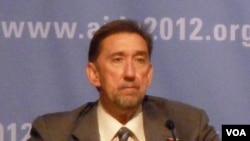
A top official at UNAIDS says in the early days of the epidemic leaders emerged not from the highest levels of government, but from the grassroots level where the disease had struck the hardest. Paul De Lay spoke at the 19th International AIDS Conference in Washington.
The UNAIDS official says when the epidemic began more than 30 years ago, individuals took the lead to care for the sick and dying. De Lay said they took the lead in getting the world to listen.
“We have to recognize that from the beginning of this epidemic – and it’s still true today – that as we’ve looked to our traditional leaders – political leaders, religious leaders, presidents, prime ministers – we’ve often seen a failure to respond to the epidemic the way it should have been responded to. And instead, we’ve had to look to nontraditional leaders. Now that’s changing. But I still something that I think is the most powerful part of the AIDS response,” he said.
Ordinary people did extraordinary things without resources and little information about the disease.
“They’ve come from the youth. They’ve come from faith-based organizations. They’ve come from communities that are affected. People living with HIV. And the workplace. And when you look back and you think of Noerine Kaleeba in Uganda, Zackie Achmet in South Africa, Larry Kramer in New York. They were our leaders. They were our leaders in a time of real need,” he said.
He said UNAIDS believes it’s important to continue to nurture, develop and support leaders.
“There are a couple of things that all leaders, all advocates, all champions truly need. First of all, they need a clear vision that’s actionable. That’s measureable. And something that they can provide a continuity for passion, for dialogue, for research. That’s critical. The other thing that a leader needs for this epidemic is a good political sense. Who they need to talk to and what’s the right time to do that talking,” said De Lay.
He added leaders need to ask two important questions: What drives risk? And what blocks access to services? The answers to those questions, he says, drive the epidemic.
“We also have to have a ruthless respect for human rights because that is the core of the response. The technologies will only take us so far. And then finally, I think that leaders need to set the direction. They need to frame the dialogues and they’re going to have to be courageous,” he said.
Despite all the scientific advances, De Lay said, “The HIV/AIDS “epidemic will always require unique courage to respond to all aspects of the response.”
The UNAIDS official says when the epidemic began more than 30 years ago, individuals took the lead to care for the sick and dying. De Lay said they took the lead in getting the world to listen.
“We have to recognize that from the beginning of this epidemic – and it’s still true today – that as we’ve looked to our traditional leaders – political leaders, religious leaders, presidents, prime ministers – we’ve often seen a failure to respond to the epidemic the way it should have been responded to. And instead, we’ve had to look to nontraditional leaders. Now that’s changing. But I still something that I think is the most powerful part of the AIDS response,” he said.
Ordinary people did extraordinary things without resources and little information about the disease.
“They’ve come from the youth. They’ve come from faith-based organizations. They’ve come from communities that are affected. People living with HIV. And the workplace. And when you look back and you think of Noerine Kaleeba in Uganda, Zackie Achmet in South Africa, Larry Kramer in New York. They were our leaders. They were our leaders in a time of real need,” he said.
He said UNAIDS believes it’s important to continue to nurture, develop and support leaders.
“There are a couple of things that all leaders, all advocates, all champions truly need. First of all, they need a clear vision that’s actionable. That’s measureable. And something that they can provide a continuity for passion, for dialogue, for research. That’s critical. The other thing that a leader needs for this epidemic is a good political sense. Who they need to talk to and what’s the right time to do that talking,” said De Lay.
He added leaders need to ask two important questions: What drives risk? And what blocks access to services? The answers to those questions, he says, drive the epidemic.
“We also have to have a ruthless respect for human rights because that is the core of the response. The technologies will only take us so far. And then finally, I think that leaders need to set the direction. They need to frame the dialogues and they’re going to have to be courageous,” he said.
Despite all the scientific advances, De Lay said, “The HIV/AIDS “epidemic will always require unique courage to respond to all aspects of the response.”