



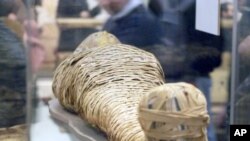
Back in 2005, when Frank Ruhli was trying to figure out how ancient Egypt's famous boy pharaoh, King Tut, died, he used CT scans of Tut's mummified remains. Now, says the renowned mummy expert, the new technology to screen some airline passengers for explosives can provide even more information.
"By applying this technology on top of another technology, it may help you to look differently at the specimen," he explains, adding that the Terahertz imaging - also known as "full body scan" technology - does not use any sort of radiation, which could destroy DNA remnants of the mummies.
"And finally, by using this Terahertz imaging, you eventually may be able to look at the substances within the mummy, for example, the embalming liquid used in the Egyptian way of embalming. There you can actually do sort of substance analysis which you can't really do by conventional x-ray."
Ruhli and his team of researchers at the Swiss Mummy Institute have just completed the first feasibility study of how they could use the technology to reveal a mummy's secrets, without damaging the mummy. He says the images they have gathered with the terahertz scans are very promising.
And he says the results are not just interesting for historians. "More and more, there are actually people aware of the fact if we want to know more about medicine or actually how to treat patients with all these health care issues, we have to look to the past as well."
Many mummies, from many times and places
The most famous mummies are the Egyptian ones, which were carefully dried out with salts, treated with oils and resins and wrapped in linen before being placed in a coffin.
But there are mummies from every historical era, from everywhere in the world. Ruhli explains that these so-called natural mummies were preserved accidentally. "There are different conditions which actually can lead to natural mummification. It's usually a combination of temperature, even air flow. Even in modern times, you can find people in apartments laying there for ten years after death and been mummified because of a specific airflow and temperature which supported the mummification procedure."
However it happens, the mummification process preserves the body's soft tissue long after it would normally have decomposed ... and with it, the virus or bacteria that may have caused the person to die.
Ruhli, who is a medical doctor as well as a paleo-pathologist, says looking back can help scientists look forward, by revealing how the disease evolved over time.
New technology spotlights direction of disease
They can even map a pathogen's genetic code, which changes from generation to generation.
Ruhli notes researchers used that technique to study the evolution of the tuberculosis bacteria from 2,000-year-old mummified tissue to modern-day strains. And scientists have done similar research on the 1918 Spanish flu epidemic.
"The fact that tissue was preserved for more than a few decades helps us to learn more about past disease and actually eventually help to avoid these kinds of diseases in the future," he says, noting that as doctors grapple with the H1N1 flu pandemic, studies like these could prove very useful.
Ruhli says such research could never replace modern clinical studies. But he says taking the long view can help provide insights scientists might miss in a snapshot from a single moment in time.
Ruhli presented his case for the value of mummies for modern medical research to scientists and doctors at the annual meeting of the American Association of Anatomists.