


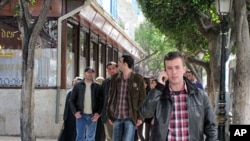
Walk down Rue Didouche Mourad - a bustling auto route lined with colonial-era buildings that winds its way toward the Algiers port - and this is what you will see: groups of children heading home from school; young girls, some with headscarves, others bareheaded, mobile phones glued to their ears; young men hanging out in cafes; a street population that is overwhelmingly young.
This is the face of Algeria. Seven out of 10 people in this North African country are less than 25 years old. These youths should be the country's wealth. But are they?
No, says Imad Boubekri, youth coordinator for the Algerian League for the Defense of Human Rights. At least, that is not the way they are seen.
Boubekri says few jobs are available for young Algerians. There is a collective anguish among the youth population here, sparking a string of self-immolations mirroring neighboring Tunisia, where the death of a young man who set himself on fire triggered a powerful revolt that toppled the country's longtime president.
But while there was rioting over high food prices in January and an ongoing series of scattered protests for disparate causes, young people here have failed to catalyze - much less lead - the kinds of national revolts against authoritarian governments witnessed in other Arab countries.
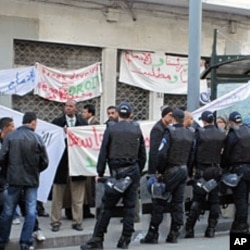
Consider a protest last weekend in Algiers by part-time school teachers demanding benefits. Mohammed Shekalel, a teacher in his late '20s who works at a school about 80 kilometers away, was among them. The protest, he said, had nothing to do with demands for political reform.
"We don't speak about politics because we don't belong to any political party. We [want] our rights concerning our jobs," said Shekalel.
Algerian students have also been protesting in front of the education ministry to demand a better recognition of their university diplomas. But again, their calls have yet to gain a political edge.
Still, youth activist Boubekri believes it is only a question of time.
Boubekri says Algeria's economic, political and social situation is very precarious. He has no doubt it will lead to a social explosion.
Boubekri was among the organizers of a youth march announced on the Internet social network Facebook last weekend aimed to demand major political reforms. Only a few dozen young people showed up, and every time they tried to gather police broke them up.
Unlike neighboring Tunisia, where Cyberspace helped drive the political revolt, the Internet has failed to galvanize the youth here.
On Didouche Mourade street, 16-year-old Ilias Fouial says he is not interested in participating in the political protests.
Ilias says that is the opposition party. His friends are not involved with that.
Is he interested in politics?
Not really, Ilias says. He is interested in sports.
That is not to say that youths have not been key members of anti-government protests that have rippled across the country in recent weeks.
But youth leader Boubekri says Algeria has one striking characteristic that other protest-roiled Arab countries do not have; the fallout of a bloody civil war in the 1990s that killed upwards of 100,000 people and continues to traumatize Algerians. It has put political militancy on hold.
But today, says Said Saadi, head of the opposition RDC party, a whole new generation of young people is growing up with little memory of the 1990s conflict.
Still, Saadi says, these young people remain barred from any kind of political participation. Young people are not going to mobilize if they do not get help and training - if there is no political dynamic to motivate them.
Communications Minister Nacer Mahel describes a series of measures the government is introducing to improve opportunities for Algeria's youth. They include incentives to get young people into farming and to start their own businesses.
Mahel says the government is aware it needs to establish better lines of communication with young people and get them involved in the political process.
Youth activist Boubekri is also planning to get young people more involved politically. He outlines plans to get youth mobilized, neighborhood by neighborhood.
Boubekri says political activists like himself are telling young people not to listen to the political establishment. He says it is up to them to change Algeria and they need to follow their convictions.