



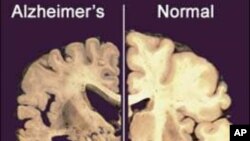
Scientists say they've developed a type of disease-fighting antibody that, in tests with laboratory mice, is able to clear away the destructive brain plaques, or protein deposits, believed to cause Alzheimer’s Disease. Researchers note that while several experimental drugs have shown promise in preventing plaque development, this new antibody therapy is the first to successfully remove existing plaques, suggesting a possible treatment for Alzheimer's patients.
By the time most people visit their doctors complaining of serious memory problems and cognitive decline, experts say their brains very likely are already riddled with sticky deposits of amyloid beta protein. These plaques are the hallmark of Alzheimer's, a progressive neurodegenerative disease that eventually leads to disability and death. According to Alzheimer’s Disease International, in 2010 there were an estimated 35.6 million people around the world suffering from various forms of dementia, including Alzheimer’s.
Researchers at drug maker Eli Lilly report their experimental antibody therapy binds to and literally sweeps away existing plaques in a mouse model of Alzheimer’s. Their new antibody is part of a trend in so-called immunotherapy in which the body's immune system proteins, or antibodies, can be engineered to target and disable specific disease-causing molecules.
In Eli Lilly's neurodegenerative section, Ronald DeMattos works on new therapies to treat and prevent Alzheimer's disease. “What we’ve been able to demonstrate is that by treatment with this antibody that is very specific to binding to this deposited sticky material… we’re actually able to remove pre-existing clumps or plaque material,” he explained.
In a healthy brain, the protein beta amyloid is normally broken down and eliminated by the body. But in people with Alzheimer’s, the dissolvable proteins accumulate and form hardened plaques.
Researchers theorize that water-soluble beta amyloid washes over existing plaques, interfering with therapeutic attempts to eliminate the buildup.
Instead of genetically engineering a drug that targeted all of the beta amyloid in an experimental group of mice bred to have Alzheimer’s disease, DeMattos and colleagues developed an antibody that attached to and eliminated only the hardened plaque deposits.
“The antibody is meant literally to enter the brain and help one’s own body facilitate the removal of this deposited plaque material. And it’s our hope that by doing so, we can hopefully mitigate some of the cognitive deficits that are attributed to the disease,”
DeMattos said.
But it remains to be seen, DeMattos says, whether elimination of hardened Alzheimer’s plaques leads to memory improvements or stops the cognitive decline associated with the disease.
Alzhiemer’s patients typically begin to develop beta amyloid deposits ten or more years before they are diagnosed, according to DeMattos, who says the ultimate goal would be to treat individuals before they develop signs of the disease.
An article on a new antibody therapy for Alzheimer’s disease is published in the journal Neuron.
By the time most people visit their doctors complaining of serious memory problems and cognitive decline, experts say their brains very likely are already riddled with sticky deposits of amyloid beta protein. These plaques are the hallmark of Alzheimer's, a progressive neurodegenerative disease that eventually leads to disability and death. According to Alzheimer’s Disease International, in 2010 there were an estimated 35.6 million people around the world suffering from various forms of dementia, including Alzheimer’s.
Researchers at drug maker Eli Lilly report their experimental antibody therapy binds to and literally sweeps away existing plaques in a mouse model of Alzheimer’s. Their new antibody is part of a trend in so-called immunotherapy in which the body's immune system proteins, or antibodies, can be engineered to target and disable specific disease-causing molecules.
In Eli Lilly's neurodegenerative section, Ronald DeMattos works on new therapies to treat and prevent Alzheimer's disease. “What we’ve been able to demonstrate is that by treatment with this antibody that is very specific to binding to this deposited sticky material… we’re actually able to remove pre-existing clumps or plaque material,” he explained.
In a healthy brain, the protein beta amyloid is normally broken down and eliminated by the body. But in people with Alzheimer’s, the dissolvable proteins accumulate and form hardened plaques.
Researchers theorize that water-soluble beta amyloid washes over existing plaques, interfering with therapeutic attempts to eliminate the buildup.
Instead of genetically engineering a drug that targeted all of the beta amyloid in an experimental group of mice bred to have Alzheimer’s disease, DeMattos and colleagues developed an antibody that attached to and eliminated only the hardened plaque deposits.
“The antibody is meant literally to enter the brain and help one’s own body facilitate the removal of this deposited plaque material. And it’s our hope that by doing so, we can hopefully mitigate some of the cognitive deficits that are attributed to the disease,”
DeMattos said.
But it remains to be seen, DeMattos says, whether elimination of hardened Alzheimer’s plaques leads to memory improvements or stops the cognitive decline associated with the disease.
Alzhiemer’s patients typically begin to develop beta amyloid deposits ten or more years before they are diagnosed, according to DeMattos, who says the ultimate goal would be to treat individuals before they develop signs of the disease.
An article on a new antibody therapy for Alzheimer’s disease is published in the journal Neuron.