


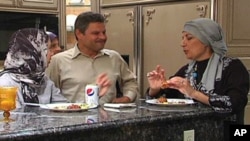
The holy month of Ramadan is marked by fasting from dawn to dusk. Muslim Americans end each day of fasting with a festive meal known as Iftar. After a long day, they relax and share the rituals of Ramadan from sundown to the predawn hours.
As the sun sets, several Muslim families gather in this home overlooking the Potomac River. They will break the daily fast together.
Each family has brought a dish to share.
Aida Mady is an interior decorator and a member of the American Muslim Women Association. She is hosting the Iftar. "We pray, we thank God every night and it reminds me of Thanksgiving, and I am grateful to God because he is giving us thirty thanksgivings not only one," she said.
Aida's husband, Ibrahim, is a physician. He graduated from Al Azhar University in Cairo, the oldest Islamic University in the world. "We break our fast drinking water and eating dates as the Prophet Muhammad, peace be upon him, used to do," he said, "and then we go and pray our first night prayer and then come back and eat our Iftar."
These five Muslim families attend the Iftar after a long day at work where they are surrounded by non-Muslims. Yusra Shawer, a policy analyst, copes with the challenge of being around people who are not fasting. "I am always reminding myself that it is the time when I remember God, be close to him, have devotion for the religion, so it is not too bad," he said.
Ramadan is an opportunity for Muslim Americans to unify and discuss issues related to the community. Dr Said Ali is a gynecologist in neighboring Maryland. "Despite the controversy over an Islamic cultural center (near Ground Zero) in New York, we are sure that the principles of our founding fathers would eventually prevail. There is no doubt that we Muslim Americans thank God every day for the freedoms our country secured for us," he said.
After the meal, the families perform the nightly prayer. "Ramadan nightly prayer is an expression of devotion and seeking forgiveness. Each night we finish reciting one chapter of the holy Koran. By the end of the holy month of Ramadan we have completed 30 chapters," he said.
Ali Gamay is a businessman. He's raising funds for a new Islamic Center in Northern Virginia.
Young Muslims at the Iftar are planning community service for the weekend. "We basically will get together at a friend's house and bag as many lunches as we can possibly make for homeless people," said one young woman.
During Ramadan, the young people here - like their parents - help the poor, whether Muslim or not.