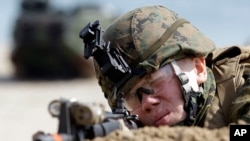
The United States and South Korea have announced plans for large-scale joint military exercises next month, just weeks after North Korea's latest nuclear test raised regional tensions.
A statement issued by the Combined Forces Command on Thursday says the annual war drills will begin on March 1 with a month-long series of air, ground and naval exercises known as Foal Eagle. Separately, it announced a two-week, computer-based simulation called Key Resolve, which will begin on March 11.
The allies' statement says the exercises are designed to enhance the security and readiness of South Korea and insists they are deterrent in nature. The North sees the drills as preparation to invade its territory.
Pyongyang has recently taken steps to demonstrate its own military power. It conducted its third and most powerful nuclear test yet on February 12. In December, it successfully launched a satellite into space, in a move critics say was a disguised ballistic missile test.
North Korea has also stepped up its violent rhetoric. This week, a North Korean diplomat threatened South Korea with "final destruction," saying Pyongyang could take further steps after the nuclear test if Seoul and its allies continue to push for tougher United Nations sanctions against its nuclear program.
Current U.N. sanctions ban North Korea from conducting nuclear or missile tests. The U.N. Security Council is currently considering expanded measures aimed at stopping the tests.
North Korea insists its nuclear weapons program is defensive in nature and necessary to counter the 28,500 American troops stationed across the border. The two Koreas have been technically in a state of war for more than 60 years. The agreement that ended the 1950-53 civil war hostilities was only a truce.
A statement issued by the Combined Forces Command on Thursday says the annual war drills will begin on March 1 with a month-long series of air, ground and naval exercises known as Foal Eagle. Separately, it announced a two-week, computer-based simulation called Key Resolve, which will begin on March 11.
The allies' statement says the exercises are designed to enhance the security and readiness of South Korea and insists they are deterrent in nature. The North sees the drills as preparation to invade its territory.
Pyongyang has recently taken steps to demonstrate its own military power. It conducted its third and most powerful nuclear test yet on February 12. In December, it successfully launched a satellite into space, in a move critics say was a disguised ballistic missile test.
North Korea has also stepped up its violent rhetoric. This week, a North Korean diplomat threatened South Korea with "final destruction," saying Pyongyang could take further steps after the nuclear test if Seoul and its allies continue to push for tougher United Nations sanctions against its nuclear program.
Current U.N. sanctions ban North Korea from conducting nuclear or missile tests. The U.N. Security Council is currently considering expanded measures aimed at stopping the tests.
North Korea insists its nuclear weapons program is defensive in nature and necessary to counter the 28,500 American troops stationed across the border. The two Koreas have been technically in a state of war for more than 60 years. The agreement that ended the 1950-53 civil war hostilities was only a truce.