


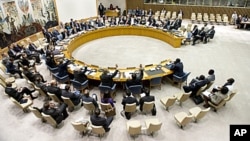
LONDON - "Failed leadership has gone global" -- according to Amnesty International's annual report on the state of human rights around the world. The United Nations Security Council is receiving the most focused criticism in the report that was published late Wednesday.
Amnesty International describes 2011 as having been a tumultuous year. On the plus side, it says, millions of people took to the streets to demand their rights -- and some secured victories. Most notably, the report says, in the Middle East and North Africa, popular movements threatened or even swept away governments that had "ruled with an iron fist."
But Amnesty says the hard work of the people was not matched by strong leadership at the national or international level.
Amnesty's London-based senior director of International Law and Policy, Widney Brown, says politicians have repeatedly responded to protests with brutality. And at an international level, she says alliances and financial interests have driven policy -- rather than human rights.
"Governments are willing to promote it when the country that they are being critical of either has no power or has no strategic importance to them. And at the same time are totally willing to bend the rules when it does," Brown said.
What is more, the Amnesty report says, the U.N. Security Council has shown itself to be tired, out of step and "unfit for purpose."
It says inaction over alleged abuses in Sri Lanka and Syria made the Security Council look redundant.
"Our concern is that the U.N. Security Council is charged with protecting international peace and security and yet in a case like Syria, where civilians are clearly being targeted, they basically chose not to act and when they did finally act, it was quite weak," Brown said.
China, France, Russia, the United Kingdom and the United States are permanent members of the Security Council.
Brown says these countries are also major arms exporters, a situation that can create a conflict of financial interest.
"Of the top six arms dealers in the world, five of those top six are permanent members of the Security Council. And there is a certain irony in the fact that the governments charged with international peace and security in fact are major arms dealers," Brown said.
Amnesty used the 2012 report to highlight the global arms trade and call for a strong global arms-trade treaty later this year. The treaty is set to be negotiated at a global conference in New York during the month of July.
Amnesty Arms Control Manager Brian Woods says if there is a risk that arms exported to another country could contribute to human-rights abuses, then those supplies should be stopped. He says a global treaty is the only way to make that work.
"Wherever we go and say look you should not have sent those arms to country 'X' or 'Y,' people will say, 'Oh yeah, but if we did not send them somebody else would.' Governments say that to us, companies say it, so there is no way you can tackle this problem unless you have a level playing field at a pretty high level for all countries," Woods said.
Amnesty International Report 2012 looks at the state of human rights in 155 countries and territories.
Amnesty International describes 2011 as having been a tumultuous year. On the plus side, it says, millions of people took to the streets to demand their rights -- and some secured victories. Most notably, the report says, in the Middle East and North Africa, popular movements threatened or even swept away governments that had "ruled with an iron fist."
But Amnesty says the hard work of the people was not matched by strong leadership at the national or international level.
Amnesty's London-based senior director of International Law and Policy, Widney Brown, says politicians have repeatedly responded to protests with brutality. And at an international level, she says alliances and financial interests have driven policy -- rather than human rights.
"Governments are willing to promote it when the country that they are being critical of either has no power or has no strategic importance to them. And at the same time are totally willing to bend the rules when it does," Brown said.
What is more, the Amnesty report says, the U.N. Security Council has shown itself to be tired, out of step and "unfit for purpose."
It says inaction over alleged abuses in Sri Lanka and Syria made the Security Council look redundant.
"Our concern is that the U.N. Security Council is charged with protecting international peace and security and yet in a case like Syria, where civilians are clearly being targeted, they basically chose not to act and when they did finally act, it was quite weak," Brown said.
China, France, Russia, the United Kingdom and the United States are permanent members of the Security Council.
Brown says these countries are also major arms exporters, a situation that can create a conflict of financial interest.
"Of the top six arms dealers in the world, five of those top six are permanent members of the Security Council. And there is a certain irony in the fact that the governments charged with international peace and security in fact are major arms dealers," Brown said.
Amnesty used the 2012 report to highlight the global arms trade and call for a strong global arms-trade treaty later this year. The treaty is set to be negotiated at a global conference in New York during the month of July.
Amnesty Arms Control Manager Brian Woods says if there is a risk that arms exported to another country could contribute to human-rights abuses, then those supplies should be stopped. He says a global treaty is the only way to make that work.
"Wherever we go and say look you should not have sent those arms to country 'X' or 'Y,' people will say, 'Oh yeah, but if we did not send them somebody else would.' Governments say that to us, companies say it, so there is no way you can tackle this problem unless you have a level playing field at a pretty high level for all countries," Woods said.
Amnesty International Report 2012 looks at the state of human rights in 155 countries and territories.