



The devastating impact of Japan's earthquake and tsunami and its ongoing nuclear crisis has led to a rare political cooperation among the country's political parties. But as the Japanese government grapples with the enormous task of recovery, analysts say it is unclear how long the political truce will last.
Shortly before the earthquake and tsunami struck, analysts say, Japanese Prime Minister Naoto Kan was fighting for his political life. His foreign minister had resigned after admitting he had accepted an illegal foreign political donation and Mr. Kan had admitted to unknowingly accepting an illegal donation as well.
The prime minister refused to step down, even as the opposition was pushing for a snap election and after members of his Democratic Party of Japan, or DPJ, had called on him to resign.
Michael Auslin of the Washington-based American Enterprise Institute for Public Policy Research says that as Japan moves beyond the initial shock of the disaster, public attention will turn to the government.
"It should not be a partisan look; it should not be a political game," said Auslin. "But it is natural that the responsibility for rebuilding the country and returning Japan to normalcy, whether it is on the energy side or the economic side or simply the side of getting daily life going ahead, will fall in no small part to the government."
Rodger Baker, vice president of strategic intelligence at STRATFOR, a global intelligence company, says he does not think that politicians in Japan will push for a change in national leadership until the crisis at the Fukushima Daiichi nuclear power plant subsides.
"Until those facilities are largely contained, the political situation is going to remain in this bit of a cease-fire that we are seeing," said Baker.
Mr. Kan is Japan's sixth prime minister in the last five years. Control of Japan's bicameral legislature is divided between Mr. Kan's Democratic Party the Liberal Democratic Party, or LDP.
Before the quake, Prime Minister Kan was struggling to pass bills in parliament to finance the country's budget. Japan's fiscal year begins next month. Now, the opposition says it will cooperate with the DPJ on an earthquake reconstruction package.
Michael Auslin of the American Enterprise Institute:
“Without question, this will be the greatest test for the DPJ as it would be of any government," he said. "However, for a government that has since taking power steadily lost support of the people, has lost elections and has seemed to be unable to deal with baseline political necessities, I think grave questions will increasingly be asked.”
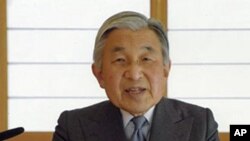
In the wake of the disaster, there has been calls for reconciliation. Japan's Emperor Akihito recently delivered a rare televised address to the nation - a message of comfort and a call for unity.
Some political commentators in Japan have voiced hope that the earthquake, tsunami and nuclear crisis will prompt Mr. Kan and the opposition to find a way to work together as the world's third largest economy faces its biggest challenge since World War II.
In a recent article in the Asahi Shimbun newspaper, Japanese political scientist Takashi Mikuriya suggested that the disaster could become a catalyst for political change in Japan, by focusing attention on rebuilding the nation.
Rodger Baker of STRATFOR says Japanese have a history of pulling together during times of crisis.
"So we do see a country that was highly fractured, at least at the political level, prior to this, that is starting to consolidate in the midst of this," he said. "And that, I think, leans again toward this idea that the Japan that comes out of this may ultimately be far different than the Japan we saw going into it."
Others analysts are less optimistic that the crisis in Japan will enable the country's two rival political parties to bridge decades of mutual mistrust.