


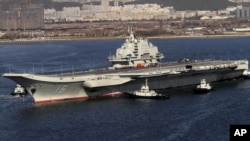
Western analysts say China's recent landing of a Russian designed fighter jet on an aircraft carrier, though significant, poses no immediate regional or international security threats.
In reports published Sunday, China's state-run news agencies said the navy landed several Chinese-made J-15 jets on the carrier Liaoning in the past week. The reports said the warplanes also took off successfully.
Chinese military analysts described the daytime landings and take-offs as a "landmark" in the navy's efforts to develop the combat capability of the Liaoning, China's first aircraft carrier.
Bonnie Glaser, senior Asia Adviser at the Washington D.C.-based Center for Strategic and International Studies, told VOA while this is a significant achievement for China, it needs to be put in perspective.
"The landing took place in good weather and it took place in the daytime. It is significantly more difficult to land an aircraft on a carrier at night and in bad weather."
The China Daily quoted a military researcher as saying it will take at least two years for the J-15s to become fully operational. He also predicted the Liaoning will need four to five years to achieve full combat capability.
Asia security analyst Michael McKinley of the Australian National University told VOA the landing and takeoff event represents China's infancy in naval aviation and is a long process of gaining operational confidence.
"It's not significant in terms of current or even short-term naval capabilities. China is a long way off of being able to project and deploy significant naval aviation power beyond its coastal fringe."
The plane
The J-15 warplane is described as a multi-purpose carrier-born fighter jet based on Russia's Sukhoi 33 fighter jet, equipped with Russian engines and capable of carrying precision-guided bombs. McKinley says despite the warplane's capabilities, the deployment on the aircraft carrier does not, now, pose a global security risk.
"What would be threatening is if China changed its political and maritime strategies to an aggressive posture. And that would require the presence of several aircraft carriers capable of deploying quite a long way into the Indian Ocean and off the coast of Africa. At the moment, and for the foreseeable future, any Chinese maritime air capability deployed at sea is going to be hostage to a great many vulnerabilities, not the least being the United States navy itself."
Glaser says while the aircraft carrier does not pose an imminent threat to the United States, it could negatively affect U.S. interests in the region.
"Potentially it could be used in the crisis in the South China Sea. It could be used against its neighbors. I think that would worry the United States. It could potentially negatively affect American interests. But it doesn't pose a direct threat to U.S. forces or the continental U.S."
Back story
China bought the vessel as an unfinished Soviet aircraft carrier from Ukraine in 1998 and spent years refurbishing it. The Liaoning entered military service on September 25. Beijing has been expanding its military capabilities while also making increasingly assertive claims to disputed maritime territories. Those claims have caused growing concern in some of China's neighbor countries.
Glaser says China understands it has to maintain good relations with its neighbors and will have to do more to meet regional concerns. But she told VOA Beijing is walking a fine line between protecting what it perceive as its interests and easing the concerns of its neighbors.
"If they emphasize their military capabilities, such as potentially deploying an aircraft carrier in the South China Sea, then that will certainly be counter-productive."
Additional reporting by Victor Beattie in Washington D.C.
In reports published Sunday, China's state-run news agencies said the navy landed several Chinese-made J-15 jets on the carrier Liaoning in the past week. The reports said the warplanes also took off successfully.
Chinese military analysts described the daytime landings and take-offs as a "landmark" in the navy's efforts to develop the combat capability of the Liaoning, China's first aircraft carrier.
Bonnie Glaser, senior Asia Adviser at the Washington D.C.-based Center for Strategic and International Studies, told VOA while this is a significant achievement for China, it needs to be put in perspective.
"The landing took place in good weather and it took place in the daytime. It is significantly more difficult to land an aircraft on a carrier at night and in bad weather."
The China Daily quoted a military researcher as saying it will take at least two years for the J-15s to become fully operational. He also predicted the Liaoning will need four to five years to achieve full combat capability.
Asia security analyst Michael McKinley of the Australian National University told VOA the landing and takeoff event represents China's infancy in naval aviation and is a long process of gaining operational confidence.
"It's not significant in terms of current or even short-term naval capabilities. China is a long way off of being able to project and deploy significant naval aviation power beyond its coastal fringe."
The plane
The J-15 warplane is described as a multi-purpose carrier-born fighter jet based on Russia's Sukhoi 33 fighter jet, equipped with Russian engines and capable of carrying precision-guided bombs. McKinley says despite the warplane's capabilities, the deployment on the aircraft carrier does not, now, pose a global security risk.
"What would be threatening is if China changed its political and maritime strategies to an aggressive posture. And that would require the presence of several aircraft carriers capable of deploying quite a long way into the Indian Ocean and off the coast of Africa. At the moment, and for the foreseeable future, any Chinese maritime air capability deployed at sea is going to be hostage to a great many vulnerabilities, not the least being the United States navy itself."
Glaser says while the aircraft carrier does not pose an imminent threat to the United States, it could negatively affect U.S. interests in the region.
"Potentially it could be used in the crisis in the South China Sea. It could be used against its neighbors. I think that would worry the United States. It could potentially negatively affect American interests. But it doesn't pose a direct threat to U.S. forces or the continental U.S."
Back story
China bought the vessel as an unfinished Soviet aircraft carrier from Ukraine in 1998 and spent years refurbishing it. The Liaoning entered military service on September 25. Beijing has been expanding its military capabilities while also making increasingly assertive claims to disputed maritime territories. Those claims have caused growing concern in some of China's neighbor countries.
Glaser says China understands it has to maintain good relations with its neighbors and will have to do more to meet regional concerns. But she told VOA Beijing is walking a fine line between protecting what it perceive as its interests and easing the concerns of its neighbors.
"If they emphasize their military capabilities, such as potentially deploying an aircraft carrier in the South China Sea, then that will certainly be counter-productive."
Additional reporting by Victor Beattie in Washington D.C.