



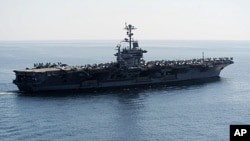
Iran’s recent threat to close the Strait of Hormuz led to a defiant U.S. response. It raised concerns of a military clash in the Persian Gulf and also raised oil prices. Some analysts do not expect the war of words to escalate into a military conflict.
Iran fired missiles and exercised its navy, amid sharp rhetoric from officials who warned the United States not to move an aircraft carrier into the Persian Gulf - something it routinely does.
U.S. officials made clear operations will continue in the Gulf, which is an international waterway.
Iran expert Mark Fitzpatrick believes Iran's threat are hollow.
“It’s laughable that anyone would think that the U.S. Navy is going to listen to Iran’s instructions and be shut out of an area of operation in international waters. It’s just not going to happen," he said. "In that sense, Iran’s threats have a kind of emptiness to them that should be readily apparent to anyone.”
Iran also threatened to close the Strait of Hormuz, through which 20 percent of the world’s oil flows - a move the United States would not tolerate. Still, Fitzpatrick says this week’s rhetoric is not likely to lead to war.
“I don’t think that we are going to see a military conflict in the weeks or couple months to come,” he added.
But he says if Iran gets closer to producing a nuclear weapon, that could trigger military moves by the United States or Israel. Iranian officials say their nuclear program is only for peaceful purposes.
Still, Iran seems to be feeling the sting of Western pressures. The U.S. and its European allies say the latest in 30 years of international sanctions are beginning to hurt Iran's economy, because they focus on oil.
“Now that sanctions are beginning to bite on Iran’s sale of oil, it gets to the very heart of the Iranian economy. So they are feeling under some great pressure. And countries under pressure react in various ways, often by lashing out,” Fitzpatrick stated.
But Fitzpatrick says the Iranian rhetoric also has a practical impact pushing up oil prices and providing Iran with a small infusion of cash.
And analyst James Brazier of the IHS consulting firm says it would be foolish for the West to ignore Iran's threats. “Iran has invested heavily in its navy, and especially in unconventional tactics that could disrupt shipping through the Strait. So as a result, I think one shouldn’t dismiss the ability of the Iranian Navy to disrupt shipping in the Gulf, but probably not for a very long time,” he said.
Experts say the Iran-U.S. tensions are likely to continue to rise and fall until either Iran builds a nuclear weapon or the West finds a way to convince Iran to halt its controversial nuclear program.