


This week, the U.N.’s nuclear watchdog agency released its toughest report yet on Iran’s nuclear program, saying it appearsTehran has worked on designing an atom bomb. While Russia and China seem to agree there are legitimate concerns about Iran’s nuclear ambitions, the two powers appear ready to block any new move to impose additional sanctions in the U.N. Security Council.
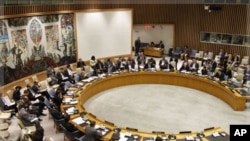
The U.N.’s most powerful organ, the 15-member Security Council, has imposed four rounds of sanctions on Iran from 2006 to 2010. The latest report from the International Atomic Energy Agency has raised the prospect that Iran’s nuclear file could come back to the Security Council for a possible fifth round of economic, financial or military sanctions.
But Moscow and Beijing have already tried to head off any move in that direction. The Russian Foreign Ministry dismissed the IAEA report as having no new information and warned that it is being used to undermine efforts to reach a political and diplomatic resolution to the issue. While Beijing has repeated its call for dialogue and said sanctions would not resolve the matter.
Analysts say the two powers do not necessarily want to see Iran become a nuclear weapons state, but preventing it is not their top priority.
Matthew Kroenig is the Stanton Nuclear Security Fellow at the Council on Foreign Relations in Washington, DC. He says Russia and China are less threatened by the thought of a nuclear armed Iran than the United States for several reasons.
“When the United States is thinking of all the things that could go wrong if Iran got nuclear weapons, it is thinking about how it is going to affect its Gulf partners -- whether it is going to have to extend security guarantees to countries like Saudi Arabia; what it means for Israel’s security - a close partner; what it means for U.S. forces in Iraq and Afghanistan,” Kroenig said.
But he says Russia and China have a much shorter list of concerns, so they are less willing to take tough measures to halt Iran’s nuclear progress. They also have close economic and trade ties with the Islamic Republic, which is the world’s fourth largest oil producer, and would be wary of jeopardizing those interests.
American University International Politics professor David Bosco says the U.N. Security Council is running out of sanctions options and only the toughest remain - including targeting Iran’s Central Bank or its oil and gas exports.
“We are at the stage where the natural next steps would really be quite coercive steps that could be aimed at crippling Iran’s entire economy and I don’t think Russia and China would go along with that,” Bosco said.
Russia and China did not use their veto power on the previous four rounds of sanctions, but they also used their influence to make sure the sanctions were not as strong as Western powers wanted them to be.
In an effort to avert new measures, Russia is promoting a plan where Iran would cooperate on inspections to alleviate questions about the nature of its nuclear program in return for a gradual lifting of existing sanctions.
Iran insists its nuclear ambitions are purely peaceful and has dismissed the IAEA report as a “fabrication”, calling the agency a “tool” for U.S. political objectives. Iran has also said recently it is willing to return to the negotiating table to settle the matter.
But after several bad experiences with Tehran, is there enough trust in the international community to engage the Iranians in dialogue? Ilan Berman of the conservative Washington research organization, the American Foreign Policy Council, says the time for talk has passed, especially after the latest IAEA report.
“There is a sense that Iran is attempting through all these different measures -- working through China and Russia and also by offering negotiations only to complicate them later down the road -- is trying to run out the clock on its nuclear effort. I think the time for returning to negotiating table with the Iranians has passed. The question is now that we know that the clock is ticking, what are we willing to do to really put the screws to the Iranians?,” Berman said.
The analysts agree that there are unilateral measures the United States and its European partners could take to try to slow Iran’s proliferation progress - such as an economic embargo or sanctions on Iran’s oil and gas exports -- but they say strong, unified action is unlikely soon at the United Nations.
Analysts: Russia, China Ready to Block New UN Sanctions on Iran